An interactive terminal AI agent you can fully undo.





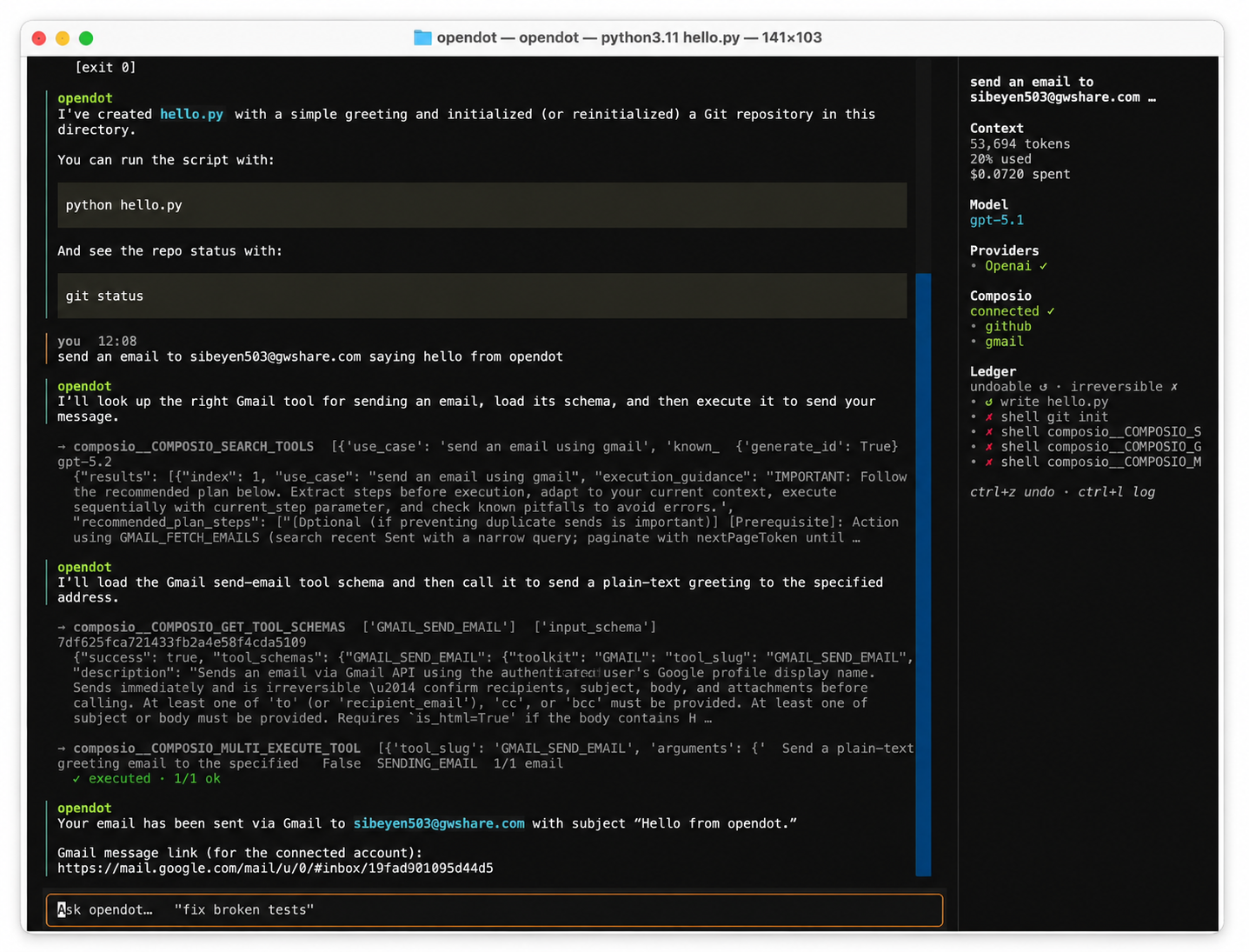
opendot works directly on your real files and shell — but unlike other terminal
agents, every action it takes is snapshotted first, so you can see exactly
what it did and cleanly walk it back. Files and shell commands, not just
in-repo edits. Commands whose effects escape your workspace (network, sudo,
git push, deleting outside the working dir) are flagged and confirmed before
they run, with an honest note about what can't be undone.
That's the point of opendot: an agent you can let loose because nothing it does is a surprise, and (almost) nothing is irreversible.
opendot is model-agnostic — it works with any model through LiteLLM (OpenAI, Anthropic, Google, DeepSeek, …) and runs fully local via Ollama. Ollama is just the zero-setup local option; use whatever backend you prefer.
# try it instantly, no install
uvx opendot

# recommended (isolated global CLI)
uv tool install opendot        # or: pipx install opendot

# also works
pip install opendotopendot # open an interactive chat
opendot -p "summarize this project" # one-shot, for scripts / CI
opendot --model claude-opus-4-5 # launch with a specific model (see below)
opendot log # audit: what has the agent done here?
opendot undo # revert the last action
opendot undo 000004 # restore the workspace to before action #4
opendot redo # re-apply the last thing you undid
opendot diff 000004 # dry-run: preview what undo-ing action #4 would change
opendot resume # continue this project's previous sessionInside the chat, slash-commands: /model (searchable model picker),
/provider (connect a provider + paste an API key), /mcp, /composio,
/log, /undo, /redo, /diff, /trace (per-model-call cost + timing),
/clear, /compact, /help.
Any model works — cloud, local, or Hugging Face. You need an API key for the
provider you want to use (opendot is BYO-key; it doesn't host models). Pick a
model and paste a key right inside the chat with /model and /provider, or
set the key in your environment and pass --model:
Provider names link to where you get a key.
| Provider | Env var | Example --model |
|---|---|---|
| OpenAI | OPENAI_API_KEY |
gpt-5.1 |
| Anthropic | ANTHROPIC_API_KEY |
claude-opus-4-5 |
GEMINI_API_KEY |
gemini/gemini-3-pro |
|
| DeepSeek | DEEPSEEK_API_KEY |
deepseek/deepseek-chat |
| Groq | GROQ_API_KEY |
groq/llama-3.3-70b-versatile |
| Hugging Face | HF_TOKEN |
huggingface/together/deepseek-ai/DeepSeek-R1 |
| Ollama (local, no key) | — | ollama/qwen3 |
Reasoning models stream their thinking live.
Local OpenAI-compatible servers (llama.cpp / llama-server, vLLM, LM Studio):
point opendot at the server with --api-base and an openai/-prefixed model.
# e.g. llama.cpp: llama-server -m model.gguf --port 8080
opendot --model openai/local --api-base http://localhost:8080/v1
Which model runs. The default is gpt-5.1. If its key (OPENAI_API_KEY)
isn't set but another provider's key is, opendot automatically switches to that
provider on launch — e.g. with only DEEPSEEK_API_KEY set, a bare opendot
uses deepseek/deepseek-chat. If no provider key is found, opendot starts
fine but the first message shows a hint to set a key or run /provider (rather
than a raw provider error). ollama/* models need no key — just a local Ollama.
Same idea as reversibility, one axis over: reversibility bounds the damage a run can do, a budget bounds the spend. Set a ceiling and opendot stops the run the moment accumulated cost or tokens cross it, instead of running to the step limit.
opendot -p "refactor this module" --usd 0.50    # stop at 50 cents of spend
opendot -p "..." --tokens 100000                # stop at 100k tokens
Use --usd when the model has known pricing; use --tokens for a self-hosted
--api-base model whose rates aren't known (a local model prices at $0, so a
token cap is the meaningful one there). The defaults come from
OPENDOT_MAX_USD / OPENDOT_MAX_TOKENS if set; an invalid or non-positive
value is ignored, and unset means unlimited (the default). When a cap is hit the
run ends with a clear budget exceeded / token limit exceeded message.
By default opendot confirms every irreversible or workspace-escaping action (and one-shot runs decline them, since there's no one to ask). For CI or an unattended run, a permission policy lets you decide up front what's allowed:
opendot -p "run the test suite and fix failures" --yes         # auto-approve prompts
opendot -p "..." --yes --deny "git push" --deny "rm -rf"       # but hard-block these
opendot -p "..." --allow "pytest" # approve only these--yesauto-approves anything that would otherwise prompt. Reversibility is unchanged: every action is still snapshotted and undoable.--allow PATTERN/--deny PATTERNmatch the action (the command or path) on word boundaries — so--deny rmmatches thermcommand, not "reformat" — or as a glob when the pattern contains*/?(e.g.--deny "git push*",--deny "*.env"). Both are repeatable.- Precedence is deny > allow > (
--yes? approve : ask) — so you can auto-approve broadly and still guarantee specific things never run.
You can pin the same rules per project in OPENDOT.md (see below), so they
travel with the repo; CLI flags merge on top.
opendot is an MCP client: connect any MCP
server and its tools become available to the agent alongside the built-in ones.
Manage them from inside the chat with /mcp (a dropdown of your servers and
their status, with "➕ Add a server"), or from the command line:
# a stdio server — put its launch command after `--`
opendot mcp add <name> --env KEY=VALUE -- <command> [args...]

# a remote server (http/sse)
opendot mcp add <name> --url <https url>

# a remote server with a static token — pass an HTTP header
opendot mcp add supabase \
  --url "https://mcp.supabase.com/mcp?project_ref=<id>&read_only=true" \
  --header "Authorization=Bearer <your-supabase-access-token>"

# a remote server that uses OAuth — authorize in your browser
opendot mcp add linear --url "https://mcp.linear.app/mcp" --oauth

opendot mcp list           # show configured servers
opendot mcp remove <name>  # remove one
Servers are stored in ~/.opendot/mcp.json and connect automatically on the
next launch; connected servers appear in the sidebar. Authenticated remote
servers work two ways: a static token via --header (e.g. Supabase's access
token), or browser OAuth via --oauth (or by typing oauth in the /mcp
add form) — opendot opens your browser to authorize, runs a one-shot local
callback server to catch the redirect, and caches the issued tokens under
~/.opendot/mcp_oauth/ (owner-readable only), refreshing them automatically.
Removing a server also forgets its cached OAuth tokens.
Because opendot can't know what an external tool does, every MCP tool call is treated as irreversible — it's confirmed before running and marked ✗ in the ledger. Your built-in file/shell actions stay snapshotted and undoable as usual.
Beyond MCP, opendot can connect to Composio's 1000+ app
tools (Gmail, Slack, GitHub, Notion, Linear, …) using your own Composio API
key. Just use /composio in the chat:
- The first
/composioasks for your Composio API key (stored in~/.opendot/composio.json, owner-readable only). - After that,
/composiolists the available apps. Pick one — if it needs OAuth, opendot opens your browser to authorize and waits for you to finish; direct/API-key connectors activate immediately. - Enabled apps appear in the sidebar; their tools load on the next launch.
Composio tools reach external services, so — like MCP — every call is treated as irreversible: confirmed first, marked ✗ in the ledger.
Drop an OPENDOT.md in your project. Its prose is given to the agent as
context. You can also control what gets snapshotted with an opendot block:
```opendot
# snapshot these even though they'd normally be skipped:
snapshot: dist
# never snapshot these:
skip: data, *.log
# permission policy (same as --allow/--deny; comma-separated, may contain spaces):
allow: pytest, ruff
deny: git push, rm -rf
```
By default opendot skips .git, node_modules, virtualenvs, and build caches
when snapshotting — your rules override those in either direction. The allow:
/ deny: lists set the project's permission policy; the --allow / --deny
CLI flags merge on top of them.
- Before every file write or shell command, opendot snapshots the working
directory into a content-addressed store in
~/.opendot(each unique file stored once, so snapshots are cheap). - Every action is recorded in an append-only ledger you can inspect with
opendot log, which shows a timeline with a▸ you are herecursor — so you can see at a glance which actions are applied and which have been undone (and are still redoable). opendot undorestores the workspace to a chosen point, exactly, andopendot redore-applies what you last undid (a wrong undo is itself reversible).opendot diffis a dry run: it shows exactly which files an undo or restore would change, before you commit to it.- Sessions persist per project, so
opendot resumepicks up the previous conversation and its ledger where you left off. - A conservative classifier decides which shell commands are workspace-
contained (auto-run, undoable) vs. escaping (confirmed first, marked
irreversible). It classifies each command in a chain independently (so a safe
a && bcan't smuggle a dangerousbpast the prompt) and treats opaque interpreters (python,bash,docker, …) as confirm-first, since a script can do anything. When unsure, it asks. Built-in file writes are additionally contained at the OS level so a symlinked path can't redirect them outside the workspace.
Honest boundary: opendot cannot undo effects that leave your machine (a sent
email, a dropped remote database, a git push). It tells you before running
those, rather than pretending otherwise.
The classifier is a heuristic that decides when to ask, not a security
boundary. It reads shell text, so it can't fully account for what an opaque
subprocess does (the script run by python foo.py is as unknowable as
python -c), and a determined adversary could race a symlink swap. That's why
interpreters are confirm-first and built-in file writes are contained at open
time — but the honest framing is that the classifier explains why a
confirmation is prudent; it is not a guarantee against hostile input.
Kernel-enforced isolation (an overlay/container for unattended runs) would be the
stronger boundary, and is planned but not yet built
(#130).
Skipping the snapshot on purpose. When opendot runs a shell command it
snapshots first — but for something you want gone (securely wiping a secret) or
a huge throwaway file, that snapshot would keep a recoverable copy in the store.
Prefixing the command opendot runs with OPENDOT_NO_SNAPSHOT=1 skips the
snapshot for that one command:
OPENDOT_NO_SNAPSHOT=1 shred secrets.txt
The action is still logged for the audit trail, but marked not-undoable (no
snapshot backs it). This only affects commands opendot itself runs; anything you
run in your own shell outside opendot is never snapshotted or logged either way.
To exclude paths from snapshotting permanently, use the skip: rule in
OPENDOT.md.
Tool output cap. Tool results are truncated so one huge file can't blow the
context. Set OPENDOT_MAX_TOOL_OUTPUT to change the per-tool character cap
(default 30000); non-integer or non-positive values keep the default.
With the optional office extra installed, the agent can read and edit
spreadsheets and documents directly:
uv tool install "opendot[office]" # or: pip install "opendot[office]"This adds tools for .xlsx (read a sheet, edit a cell, append rows, create a
sheet), .pptx (read slides), and .docx (read paragraphs). Spreadsheet edits
go through the same snapshot-first path as any other file write, so they're
undoable like everything else.
Issues and PRs welcome — see CONTRIBUTING.md for setup and the one hard rule (don't break reversibility). Security reports go through SECURITY.md.
git clone https://github.com/vedaant00/opendot
cd opendot
uv pip install -e ".[dev]"   # or: pip install -e ".[dev]"
pytestEarly (alpha). The interactive agent, local tools, and the full reversibility
engine (undo, redo, diff preview, and a you are here timeline) work and are
tested. Streaming, slash-commands, OPENDOT.md rules, per-project session
resume, spend/token budgets, a permission policy (--yes / allow-deny) for
unattended runs, an end-of-session summary, MCP and Composio connectors, and
office (.xlsx/.pptx/.docx) tools are in. A richer TUI and more tools are
coming.