Condux is a source-available error monitoring platform with a built-in AI fix engine.
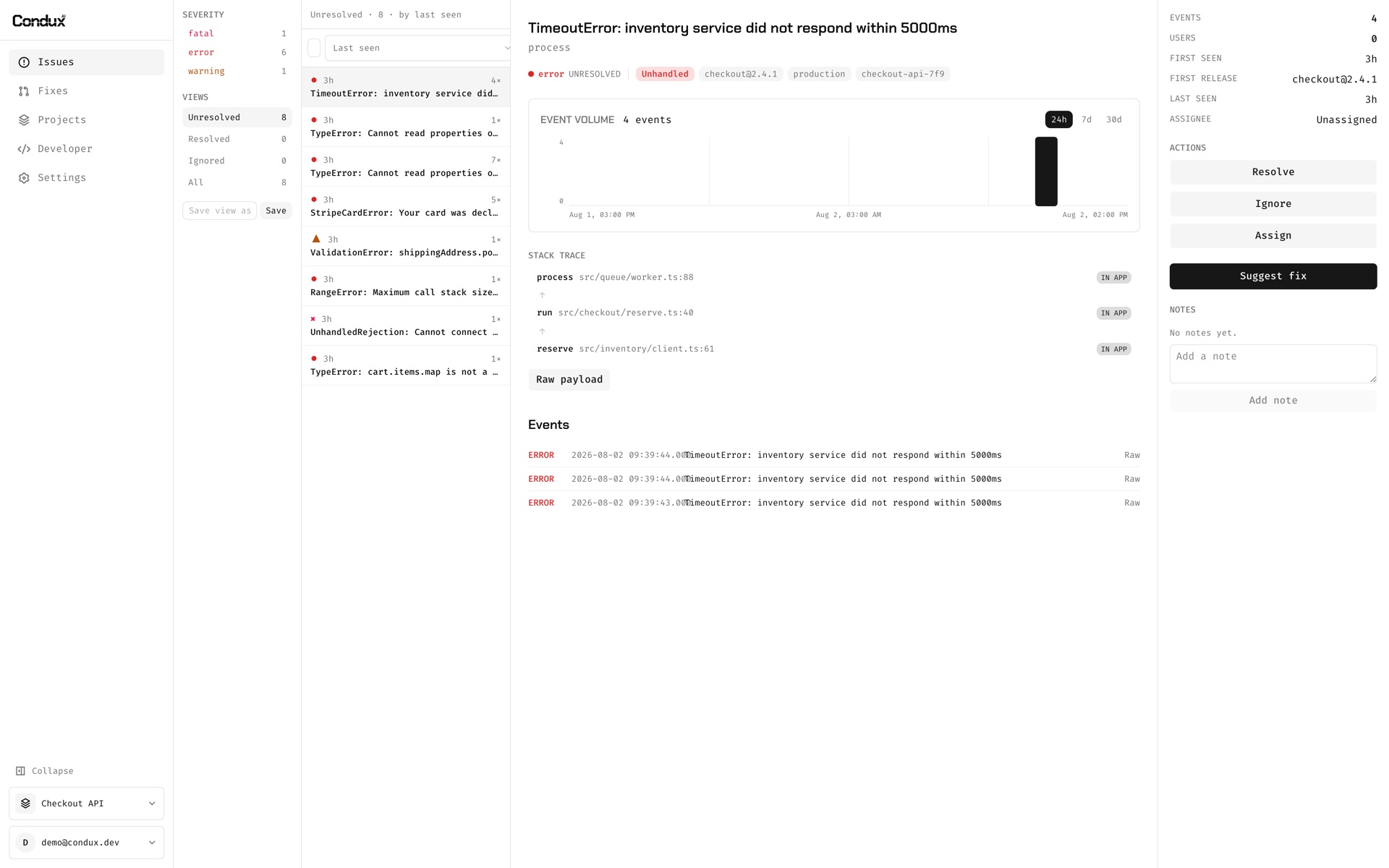
SDKs report errors to a stateless ingest relay, which authenticates the DSN, applies per-plan rate limits and quotas, and scrubs PII before buffering through Redpanda. A consumer fingerprints and groups events into issues, writes time series to ClickHouse and issue state to PostgreSQL. A Next.js dashboard reads that back as grouped issues with stack traces, breadcrumbs, tag facets and per-hour charts, and alerting fires on new and regressed issues to email, Slack, Discord and webhooks.
The fix engine takes an issue to a draft pull request. It assembles a scoped, scrubbed context from the stack trace and the project's code mappings, sends it to Claude or to a model the organisation supplies, and applies the returned changes on a new branch as a draft pull request. Fixes are never merged automatically.
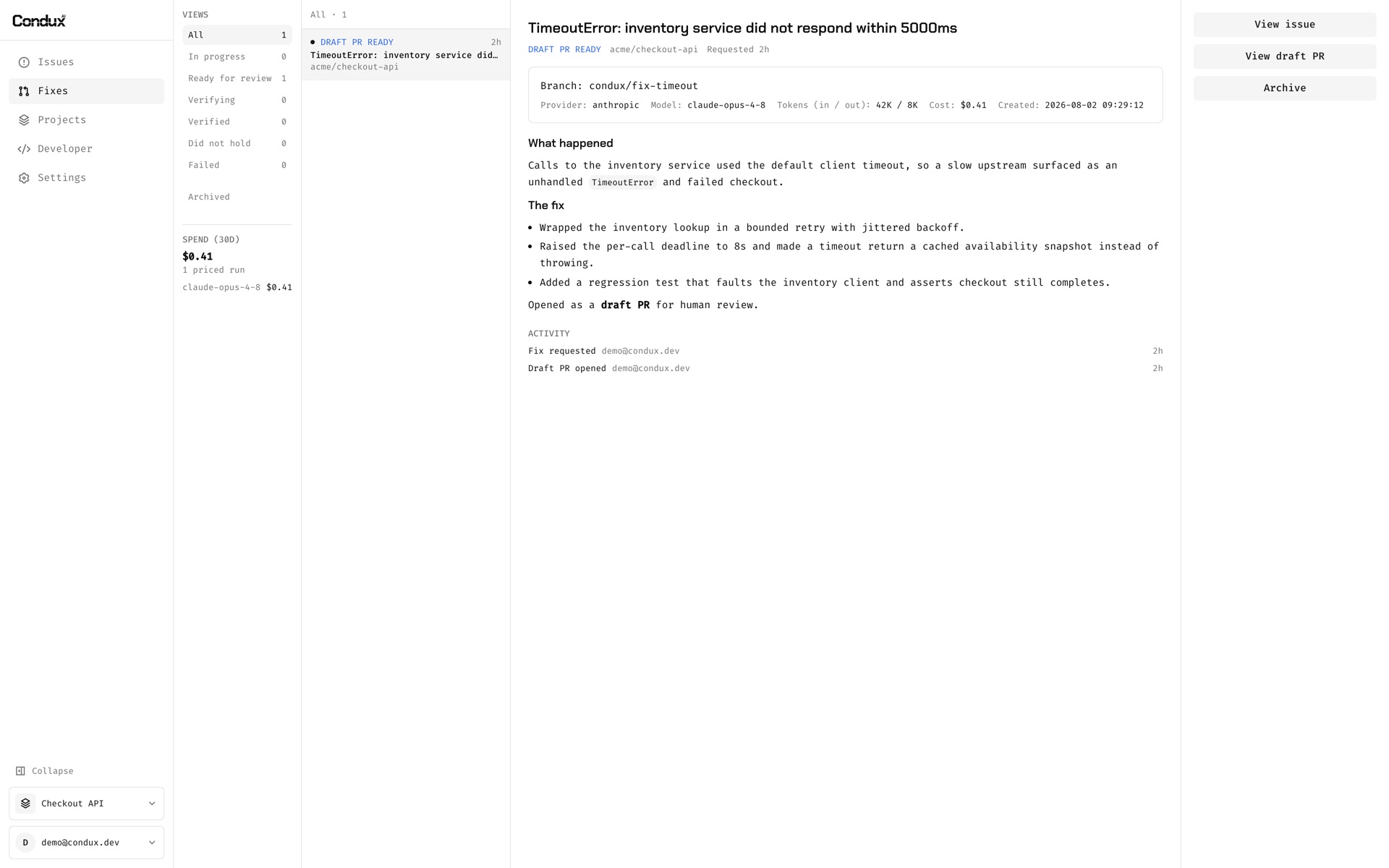
Repository access is a GitHub App with short-lived installation tokens; the model is not given the token. After a fix PR merges, a verification loop compares the issue against its subsequent event counts and resolves it once it stays silent for a configured window.
Open Dependabot findings on a connected repository can be turned into dependency-bump draft PRs through the same engine.
Each run is metered against the organisation's monthly allowance and a spend ceiling, with per-run cost derived from recorded model token usage.
Ingestion accepts the Sentry envelope and store formats, so an existing Sentry SDK reports to Condux by changing its DSN. OTLP/HTTP logs are also accepted, which lets an OpenTelemetry-instrumented application report without an SDK.
First-party SDKs are published for JavaScript/Node, browser, edge, Next.js, Python, Go, Ruby, PHP, JVM and .NET, with framework adapters for React, Express, Flask/Django/FastAPI, Rails, ASP.NET Core and Spring Boot. The SDKs are Apache-2.0; the server is FSL.
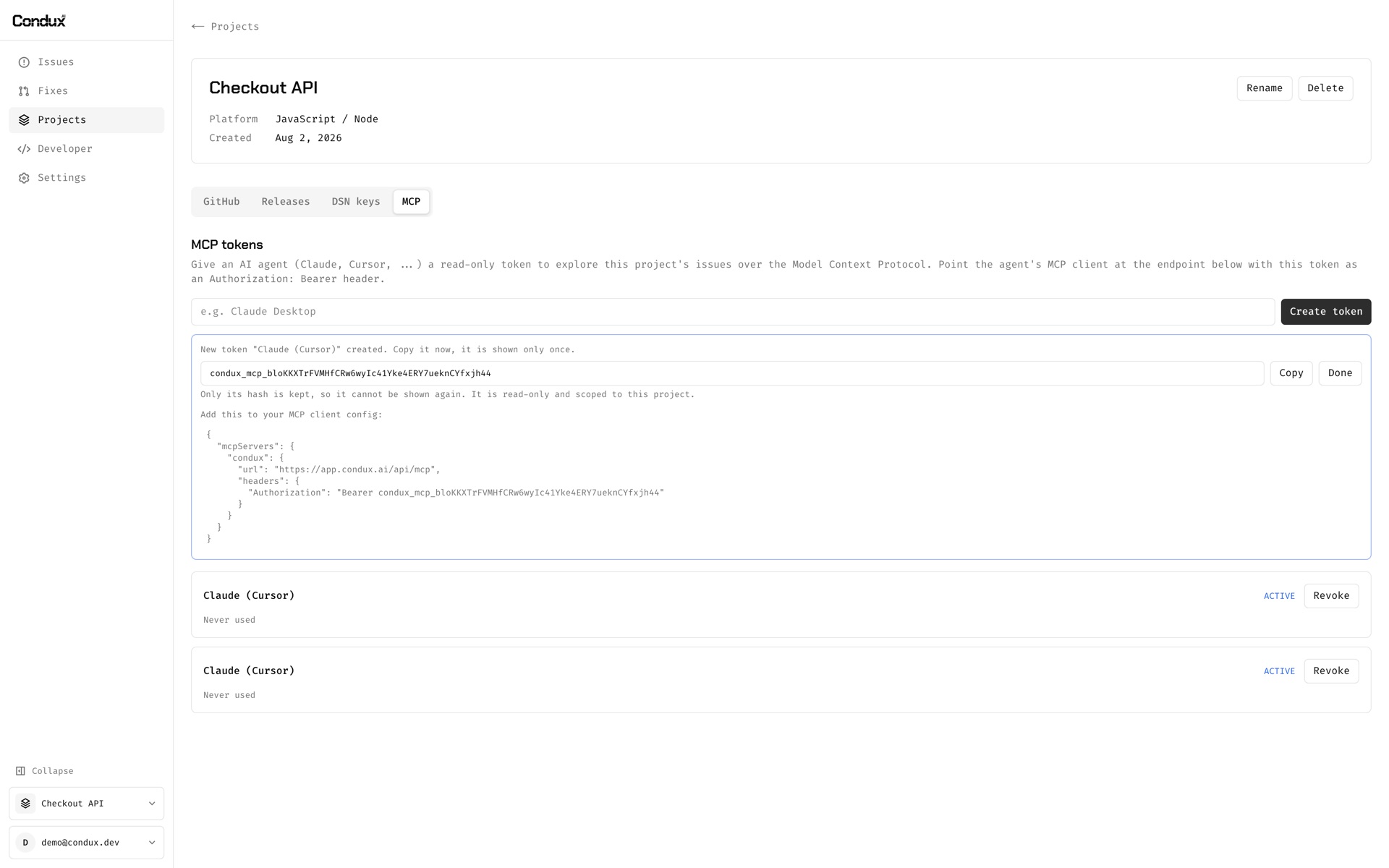
A read-only Model Context Protocol endpoint lets an AI agent debug against real production errors. Point Claude, Cursor or any MCP client at a project with a scoped token and it can list issues, read stack traces and page through occurrences. There are no write tools, and a token resolves to exactly one project.
.NET 10 services and a Next.js / React / TypeScript dashboard.
 SDKs ──envelope──▶ [Relay] ──▶ [Redpanda] ──▶ [Consumer] ──▶ ClickHouse (events, time series)
                                                          └──▶ PostgreSQL (issues, orgs, audit)
 Dashboard ──▶ [ControlPlane] ──▶ [Conductor] ──▶ draft PR
Valkey backs rate limiting and monthly quotas. The relay holds no state. Raw events expire per plan through a column-driven ClickHouse TTL rather than a scheduled job.
| Path | Contents |
|---|---|
backend/ |
.NET solution: Condux.Relay (ingest), Condux.ControlPlane (API), Condux.Consumer, Condux.Conductor (fix engine), Condux.Core (scrubbing, grouping, plans, quotas) |
web/ |
Next.js dashboard |
sdks/ |
Client SDKs and framework adapters |
packages/ |
Shared frontend packages |
proto/ |
Protobuf contracts |
migrations/ |
PostgreSQL and ClickHouse schema, numbered and idempotent |
contracts/ |
Exported OpenAPI document and Postman collection |
deploy/ |
Docker Compose stack and Helm chart |
examples/ |
Sample applications that report errors |
- .NET SDK 10.0 or later
- Node 22 or later, with pnpm
- Docker and Compose
cp deploy/.env.example deploy/.env
docker compose --env-file deploy/.env -f deploy/docker-compose.yml up -d
The dashboard listens on port 3000 and the API on 8080.
Building and testing from source:
cd backend && dotnet build Condux.sln -c Release
cd backend && dotnet test Condux.sln --filter "Category!=Integration"
cd web && pnpm install && pnpm build
Integration tests start real datastores through Testcontainers and bind the same ports as the Compose stack, so run them with that stack stopped.
deploy/docker-compose.yml runs the whole platform on a single host. deploy/charts/condux is a Helm
chart that deploys the services against externally managed PostgreSQL, ClickHouse and a Kafka-API
broker rather than running datastores in the cluster. Its README.md
covers the values, including config.ingestHost, which is required because every DSN the control plane
mints points at it. You build and push the service images yourself; the chart does not ship any.
Report suspected vulnerabilities privately by email as described in SECURITY.md, rather
than in a public issue or pull request.
Condux is source-available under the Functional Source License (FSL-1.1-ALv2). It may be read, self-hosted and modified for any purpose other than offering a competing commercial service, and each release converts to Apache-2.0 two years after it is published.
See LICENSE for the terms and LICENSING.md for a plain-language summary.
The SDKs under sdks/ are Apache-2.0.