




A block-structured, deterministic, scheduler-driven PDE simulation framework in Rust.
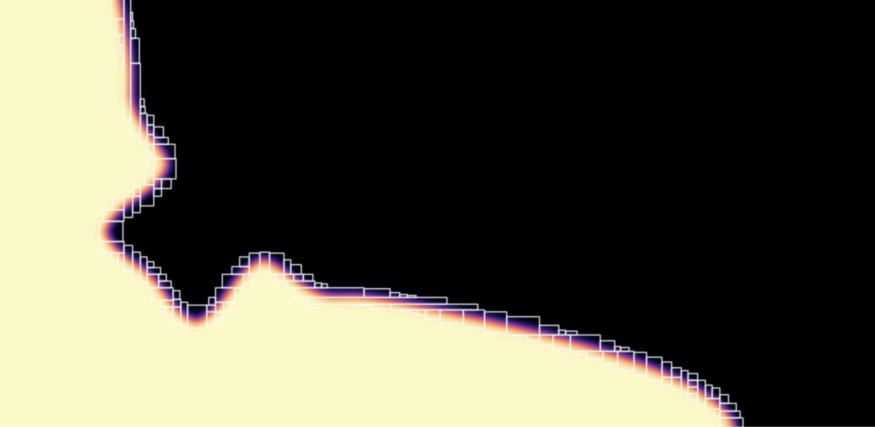
The image is real output, not artwork: a Karma–Rappel Model C solidification
front from examples/model_c and AMR subcycling, rendered with
scripts/render_model_c.py.
legendre solves systems of time-dependent partial differential equations — deterministic or stochastic, in any spatial dimension — on block-decomposed structured grids, with zero-cost abstractions separating the mathematics (models, operators) from the numerics (discretization policies, integrators) from the execution (schedulers, storage, observation).
Phase-field solidification, reaction–diffusion, and heat transport are models here, not the framework: the same trait surface that runs a 100-million-cell dendritic nucleation study runs a 3D heat equation from ~60 lines of model code.
┌─────────────────────────────────────────────────────────────────┐
│  ∂φ/∂t = ∇·[A²∇φ − AA′∂⊥φ] + φ − φ³ − λu(1−φ²)² + b·ξ(x,t)      │
│  ∂u/∂t = D∇²u + ½ ∂φ/∂t                                         │
│                                                                 │
│  · 101,606,400 cells · 6,400 blocks · bit-reproducible ·        │
└─────────────────────────────────────────────────────────────────┘
- Design principles
- Architecture
- The trait hierarchy
- The timestep
- Determinism guarantees
- Observation pipeline
- What is included
- Quick start
- Rendering results
- Validation
- Performance
- Scope: what this framework can and cannot solve
- Roadmap
- License
The architecture follows four rules, enforced by the type system rather than by convention:
1. Mathematical objects own no execution. A
Modelcannot spawn threads. AGridcannot write files. AnOperatorcannot allocate. If a trait's job is mathematics, its signature cannot express side effects.
2. Execution is scheduler-driven. Everything runs because the
Schedulerdispatches it. Exactly one module in the crate is permitted to name Rayon; aSerialScheduleris the semantics oracle that every parallel scheduler must reproduce bit-for-bit (and tests enforce this).
3. Storage is separate from views. Fields are typed views into opaque storage backends produced by an
Allocatorexactly once, at setup. Nothing allocates in the hot loop — scratch memory is a worker-pinned pool, integrator stages are pre-allocated, and snapshot buffers cycle through a fixed ring.
4. Numerical methods are policies.
Grid + Discretization → Operators. A model states what it needs (D: Discretizes<G, Laplacian>) and never learns how it was realized. Swapping second-order finite differences for a finite-volume scheme changes one type parameter, zero model code.
Every object has exactly one owner and one responsibility:
                        Simulation
                            │
        ┌────────┬──────────┼──────────┬───────────┬─────────┐
        │        │          │          │           │         │
    Scheduler  State      Grid   Discretization  Model   Integrator
        │        │          │          │           │         │
        │    ┌───┴───┐   Blocks    Stencils     V₀(Y,t)   stages,
     blocks  │Storage│      │          │        Vⱼ(Y) noise axpy
      → CPU  │ Views │   topology  operators                 │
             └───────┘                                       │
        ┌────────────┐                                       │
        │ Observers  │ ◄── notified after each completed step┘
        │ (async)    │
        └────────────┘
Even a uniform Cartesian grid is a collection of congruent blocks. This one decision buys cache locality, natural parallel work units, perimeter-local halo exchange, and an execution model that is unchanged by adaptive mesh refinement — refinement replaces one block with children and the scheduler never notices, which is exactly how AmrGrid runs behind the same Grid trait.
   Grid                    one Block (ghost-inclusive slab)
   ┌────┬────┬────┐        ╔═══════════════════╗
   │ B0 │ B1 │ B2 │        ║ g  g  g  g  g  g  ║   g = ghost ring
   ├────┼────┼────┤        ║ g ┌─────────────┐ ║       (halo-exchanged from
   │ B3 │ B4 │ B5 │  ───►  ║ g │  interior   │ ║        neighbors, or filled
   ├────┼────┼────┤        ║ g │  cells      │ ║        by the model's BCs)
   │ B6 │ B7 │ B8 │        ║ g └─────────────┘ ║
   └────┴────┴────┘        ╚═══════════════════╝
State is stored block-major (blocks × fields): each block bundles every field slab it owns, so the scheduler hands each worker a structurally disjoint &mut BlockStorage — parallel mutation with no interior mutability and no unsafe.
   Allocator ──alloc once──►  StorageBackend  ──borrow──►  G::View<'_, T>
   (system heap today;        (opaque slab:                (typed, ghost-aware,
    pools / mmap / GPU         DenseStorage,                grid-associated GAT;
    later, zero trait          later Blocked/               monomorphizes to a
    changes downstream)        Adaptive/Gpu)                single indexed load)
Views are grid-associated types (GATs): the grid wraps a raw slab in a view that knows the block's extent and ghost width. Under AMR, a grid can hand out views that transparently handle coarse–fine interpolation — without any stencil signature changing.
| Trait | Owns | Cannot |
|---|---|---|
Grid |
topology, block layout, index→coordinate maps, typed views | hold field data, do IO |
StorageBackend / Allocator |
bytes; the single allocation point | know arithmetic exists |
State |
named fields over blocked storage; vector-space ops (axpy, copy, noise) |
know physics or schemes |
Stencil<G> |
one operator realization on one block (ghost width, apply) | allocate, know physics |
Discretizes<G, Op> |
policy: realize mathematical operator Op on grid G as a stencil |
— (open universe: new operators break nothing) |
Model<G, D> |
the PDE: fields, RHS, noise amplitude, boundary conditions | mutate state, see dt, spawn work |
Integrator<G, D> |
the timestep: stage buffers, dt scaling (incl. √dt noise) |
index space — stages are pure vector algebra |
Scheduler |
dispatching disjoint block work with worker-pinned scratch | change results (bitwise identity enforced) |
Observer / SnapshotSink |
consuming completed steps / snapshots | block the solver |
The policy pattern in one picture:
        Grid              +        Discretization        →      Stencil
   CartesianGrid<2>              FiniteDifference              CentralLaplacian
   CartesianGrid<2>              FiniteVolume                  KarmaRappelFlux
   CartesianGrid<3>              FiniteDifference              CentralLaplacian
   QuadTree (future)             FiniteVolume                  (coarse–fine aware)

   Model:  impl<G, D> Model<G, D> for Diffusion
           where D: Discretizes<G, Laplacian>          ← states *what*, never *how*
Dimension is an associated fact, not a trait parameter. Concrete grids carry const D: usize; generic solver code never touches it. The 2D and 3D heat models in this repository are the same source text.
Model::step() does not exist. Models expose rhs (dY/dt) and never mutate state; the integrator owns updates — which is what makes multi-stage schemes trivial:
 Simulation::step(dt)
        │
        ▼
   Integrator ──────────────────────────────────────────────┐
        │                                                   │
        │  for each stage:                                  │
        │    Model::fill_ghosts(grid, state, t_stage)       │  halos + BCs
        │    Scheduler::for_each_block ──► vector fields    │  parallel, disjoint
        │                                                   │
        │  combine stages:  state.axpy_with(scheduler, …)   │  pure vector algebra
        │  stochastic term: state += Σⱼ √dt · Vⱼ(Y) ∘ ξⱼ    │  counter-based ξ
        └───────────────────────────────────────────────────┘
        │
        ▼
   Observers (async pipeline; never blocks the solver)
Because every state-shaped buffer (integrator stages, RHS accumulators, noise amplitudes) is slab-congruent with the state, integrators are grid-, dimension-, and scheme-agnostic vector algebra. RK4 is ~40 lines.
Dynamics are driver-indexed vector fields. A model is dY = V₀(Y,t)·dt + Σⱼ Vⱼ(Y,t)·dWⱼ: one vector_field_block(driver, …) evaluates the field conjugate to the time driver or to any of the model's independent Wiener drivers, and the model's driver set is a type (NoNoise, Wiener<M>). The √dt lives in the integrator, not the model; scaling noise by dt instead of √dt — a classic bug in hand-rolled stochastic solvers — is inexpressible here. So is pairing a deterministic-only scheme with a stochastic model: RungeKutta4 implements Integrator<G, D, NoNoise> only, so that mistake is a compile error. Correlated components need nothing from the framework — drivers are independent by construction, and a model expresses correlation by mixing drivers across its fields (the Cholesky factor is model mathematics).
Reproducibility is a design constraint, not an aspiration:
- Scheduling-independence. Block writes are disjoint and land at fixed slab locations; the test suite asserts serial and Rayon runs are bitwise identical — including stochastic runs.
- Counter-based noise. There is no RNG stream to advance. Every random increment is a pure function of
(seed, step, driver, block, cell)via a SplitMix64 chain + Box–Muller. Any worker, any thread count, any execution order: identical noise. Reproducing a run requires only its seed. - Fixed-order reductions (planned, see roadmap) will extend the same guarantee to inner products for the implicit stack.
The solver never blocks on IO. Snapshots move through a pre-allocated ring and a bounded mpsc channel to a background tokio runtime where sinks do the slow work:
 solver thread                        background thread (tokio)
 ─────────────                        ─────────────────────────
 observe(step, t, &state)
   ├─ free ring buffer? ──no──► skip (counted, never blocks)
   ├─ copy_from(state)                    ▼
   └─ try_send ────bounded mpsc───► ParquetSink ── snap_0042000.parquet
                                    FieldStatsSink ── progress bar stats
                 ◄────buffer return──────┘
Backpressure degrades observation, never simulation: if sinks fall behind, snapshots are dropped and counted. One Parquet file per snapshot means a killed run keeps every completed snapshot (a parquet file is valid only once its footer lands).
The on-disk format separates what changes from what doesn't — and is already shaped for AMR:
run_dir/
├── static_<epoch>.parquet   x, y[, z] + static fields (θ₀, …), one per grid epoch
└── snap_<step>.parquet      step, t, epoch + dynamic fields, joined by row order
Coordinates and time-invariant fields are written once per grid epoch (a uniform run has exactly one; an AMR regrid bumps the epoch and emits a fresh static file — snapshots name their epoch in a ~free RLE column). Rows stream through bounded row groups (4M rows), so the writer's transient memory is flat in domain size instead of materializing multi-GB whole-domain columns that could evict the simulation's own state.
Live progress via indicatif:
⠁ [00:01:12] ████████████░░░░░░░░ 45231/187000 (628 steps/s, eta 3m 46s)
  t=723.7 | phi∈[-1.00,1.00] ⟨phi⟩=-0.53 frac>0: 23.4% | u∈[-0.70,0.09] ⟨u⟩=-0.512
| Layer | Shipped today |
|---|---|
| Geometry | CartesianGrid<const D> (uniform, block-tiled, any dimension, per-dimension periodic wrap via with_periodic), signed ghost indexing, dimension-sweep halo exchange with per-face physical boundary conditions on non-periodic faces (FaceBc chosen per (dimension, side) via fill_ghosts_bc: no-flux mirror, Dirichlet, or prescribed flux — the latter two Cartesian-only for now), fill_from_fn declarative initial conditions |
| AMR | Berger–Oliger block-structured refinement behind the same Grid trait: AmrGrid<const D> patch hierarchies (proper nesting and ratio alignment enforced at construction), Berger–Rigoutsos signature clustering, conservative restriction + bilinear prolongation, and adaptivity as a defaulted Adapt policy on Simulation (BergerOliger + GradientTagger; Static no-op default). Runs global-dt (any integrator) or time-subcycled (Subcycling: coarse levels take big steps, finer levels r²/r substeps derived from the model's stability law, with time-interpolated coarse boundaries) |
| Discretization | FiniteDifference (central, 2nd order), FiniteVolume (Karma–Rappel anisotropic flux divergence); operator tags Laplacian, Gradient, Divergence, AnisotropicDivergence |
| Integrators | ForwardEuler, EulerMaruyama (√dt-correct stochastic), RungeKutta4 (O(dt⁴) drift, composable with noise), Subcycling (Berger–Oliger refined timestepping on AmrGrid) |
| Models | ModelC — Karma–Rappel dendritic solidification: coupled φ/u, 4-fold anisotropy, multi-grain nucleation with per-grain crystallographic orientation (static θ₀(x) field via nearest-seed Voronoi; anisotropy evaluated as A(θ − θ₀)); O(cells + blocks·grains) initialization |
| Execution | SerialScheduler (oracle), RayonScheduler (work-stealing), worker-pinned ScratchPool, scheduler-parallel state algebra |
| Observation | AsyncObserver pipeline, ParquetObserver<D> (long-format, snappy, x/y/z columns), FieldStatsSink + indicatif progress, movie rendering script (scripts/render_model_c.py) |
| Stochastics | counter-based, schedule-independent Gaussian field noise (util::rng) |
A complete model — the D-dimensional heat equation — lives in the crate-root docs and compiles as a doctest; the same pattern at full scale is examples/heat3d.rs. Defining a model means implementing register_fields, fill_ghosts, and vector_field_block; everything else (parallelism, stage buffers, output) is wiring:
let grid = CartesianGrid::new([96; 3], [32; 3], [0.0; 3], [0.1; 3])?;
let mut sim = Simulation::new(
    grid, FiniteDifference, Heat::<3> { kappa: 0.7, u: None },
    ForwardEuler, RayonScheduler, SystemAllocator,
);

let observer = AsyncObserver::new(
    200,                        // snapshot cadence (steps)
    sim.snapshot_buffers(3),    // pre-allocated ring
    vec![Box::new(parquet_sink), Box::new(stats_sink)],
);
sim.attach_observer(Box::new(observer));

let dt = sim.stable_dt().unwrap();
for _ in 0..steps { sim.step(dt); }
Run the shipped examples (--help lists every flag):
# classic single dendrite (630², corner seed), Parquet + progress + stats
cargo run --release --example model_c

# macroscale nucleation: 101.6M cells, 1000 grains, random orientations,
# stochastic sidebranching
RUSTFLAGS="-C target-cpu=native" cargo build --profile maxperf --example model_c
./target/maxperf/examples/model_c --cells 10080 --block 126 \
    --seeds 1000 --orient --noise 0.02 --time 350 --every 4000 --ring 2

# 3D heat diffusion through the same pipeline
cargo run --release --example heat3dRuns are rendered to video with the bundled Python script (numpy + pyarrow + matplotlib; ffmpeg on PATH for .mp4):
python3 -m venv .venv
.venv/bin/pip install -r scripts/requirements.txt

.venv/bin/python scripts/render_model_c.py data/model_c --out dendrite.mp4
.venv/bin/python scripts/render_model_c.py data/model_c --field u      # thermal field
.venv/bin/python scripts/render_model_c.py data/model_c --grains       # color by θ₀
.venv/bin/python scripts/render_model_c.py data/heat3d --field u       # 3D mid-plane slice
The script reads the epoch-static + snapshot Parquet layout directly and reconstructs frames through the coordinate columns, so it is exact for any block decomposition and dimension (3D runs render the mid-plane slice).
Every layer is pinned by an exactness test, not a tolerance hand-wave:
| Test | What it proves | Criterion |
|---|---|---|
| 2D/3D discrete eigenmode decay | grid, views, halo exchange, stencil, integrator, vector algebra — the whole chain | matches the analytic per-step amplification factor to 1e−10 over 200 steps |
| RK4 eigenmode decay | multi-stage plumbing incl. per-stage ghost refills | matches the quartic Taylor factor 1 − z + z²/2 − z³/6 + z⁴/24 exactly (RK4 is exact for linear modes) |
| Convergence orders | stage weights on a nonlinear problem | observed order ≈ 1 (Euler), ≈ 4 (RK4) under dt halving |
| serial ≡ parallel | scheduling-independence, incl. stochastic runs | bitwise equality |
| 3D heat conservation | mirror BCs + stencil are exactly conservative | Σu constant to all printed digits over 1050 steps |
| Solidification physics | the shipped phase-field model | φ stays in its wells, seed grows, latent heat bounded by the melting point |
| Halo exchange / mirror BCs | exact ghost values, every layer, cross-block and boundary | cell-exact assertions |
| Periodic boundaries | topology-level wrap: exact ghosts (multi-block, self-wrap, corners) + periodic eigenmode decay | cell-exact + 1e-10 relative |
| Boundary conditions | per-face Dirichlet & inhomogeneous-flux ghosts (incl. ghost-width 2), coexistence with halo exchange, block-vs-ghost-width guard, a Dirichlet-walls heat model | cell-exact ghosts; the linear steady profile is a discrete fixed point |
| AMR patches | stencils on a patch vs. a uniform twin grid; full-fine-tiling run vs. uniform run | bitwise identical |
| AMR intergrid | linear fields through exchange/prolongation/restriction; migration through copy + prolong paths | exact to 1e-12 |
| AMR adaptivity | adaptive vs. coarse vs. restricted-fine reference; Model C interface tracked by |∇φ| tagging | adaptive strictly beats coarse; interface cells always refined |
| AMR subcycling | fully-tiled subcycled run vs. uniform-fine twin; adaptive run vs. scheduler swap (serial vs. Rayon) | bitwise identical; scheduler-independent |
| Static-field layout | tendency buffers skip zero-tendency fields | zero-length slabs; axpy/noise leave statics bit-identical |
| Parquet round-trip | the on-disk snapshot contract | doubles round-trip bit-for-bit; row order matches the static file |
| Async pipeline | delivery, ring recycling, drain-on-shutdown | exact snapshot schedule received; finish() runs |
| Counter RNG | distribution + determinism | mean/variance of 2·10⁵ deviates; key sensitivity |
A numerical note recorded in the code: the textbook explicit thermal step dt = 0.25 h²/D sits exactly on the 2D stability limit, where the grid-scale checkerboard mode is undamped and secularly forced by latent-heat release — it eventually blows up. legendre uses r = 0.2 (damping factor −0.6) and documents why.
Measured on Apple Silicon (12 cores), release profile:
- 210² × 25,000 steps ≈ 7–8 s (≈ 7 ns per cell-step, observation included) for the dendritic solidification model.
- 101.6M cells (10080² as 80×80 blocks of 126²) runs at ~12 GB peak with Euler–Maruyama + a 2-deep snapshot ring; multi-seed initialization is O(cells + blocks·seeds) and takes seconds, not hours.
- No allocation after
Simulation::new: field storage, stage buffers, worker-pinned scratch, and the snapshot ring are all created once. - Blocks are the parallel unit; state algebra (
axpy, copies, noise) is scheduler-dispatched too, since at large volume those memory-bound sweeps would otherwise dominate multi-stage integrators.
For maximum throughput: --profile maxperf (fat LTO, single codegen unit) + RUSTFLAGS="-C target-cpu=native"; PGO adds ~5–10% on top via cargo-pgo.
There's a few limitations of the current design, and some ideas for next steps.
Any method-of-lines system ∂Y/∂t = F(Y, ∇Y, ∇²Y, …, x, t) + Σⱼ Vⱼ(Y)·ξⱼ where F is evaluable cell-locally from a ghost-filled neighborhood:
- Parabolic: heat, diffusion, reaction–diffusion (Gray–Scott, FitzHugh–Nagumo, …)
- Phase-field: Allen–Cahn, dendritic solidification (shipped), Cahn–Hilliard (biharmonic = ghost width 2, already supported per-field)
- Coupled multi-field systems with cross-field RHS dependencies (the shipped model's
∂u/∂treads the freshly computed∂φ/∂tvia split borrows) - Stochastic PDEs with additive or multiplicative noise, bit-reproducibly
- Hyperbolic (advection, Burgers, wave as first-order system, shallow water): the traits are sufficient; what's needed are upwind/WENO/limiter stencil implementations — new
Stencilimpls, zero trait changes. Wide stencils are supported via per-field ghost widths.
| Class | Missing piece | Why it's additive |
|---|---|---|
| Elliptic / implicit (Poisson, steady states, stiff implicit stepping) | deterministic State::dot/norm reductions → matrix-free Krylov (CG/BiCGStab) → ImplicitIntegrator |
a Stencil is already a linear operator y = Ax, and State is already the vector space Krylov needs; no existing trait changes |
| Incompressible Navier–Stokes, quasi-static elasticity | the implicit stack above (pressure projection / global solve) | models-as-bounds pattern unchanged |
| IMEX splitting for stiff reactions | optional stiff/non-stiff RHS split on Model |
default method, existing models unaffected |
| Adaptive CFL (advection-dominated) | stable_dt currently cannot see the state; needs the same reductions |
optional stable_dt_state method |
| AMR refluxing (Berger–Colella conservation fix-up) | flux registers at coarse–fine faces correct the coarse solution for the fine fluxes that crossed them | subcycled refined timestepping already ships (Subcycling); refluxing is a flux-register layer on the existing intergrid transfers |
- Global / nonlocal operators — spectral (FFT) methods, integral terms, boundary-integral formulations.
Discretizes::Stencildeliberately binds operator realizations to block-local computation. (The serial pre-RHS phase can materialize nonlocal terms into auxiliary fields — see thestencilmodule docs — but a first-classDiscretizesGlobaltrait deserves its own design round.) - Single-input stencils —
Stencil::applytakes one input field. Multi-input operators (the oriented anisotropic divergence reads φ and θ₀) currently use inherent methods on the concrete stencil, pinning the model to that stencil family via an associated-type bound. Generalizing the stencil arity is a known, contained extension. - Stretched / curvilinear grids —
spacingis per-block uniform (right for uniform grids and level-based AMR); per-cell metrics would extend theGridsurface. - Unstructured meshes / FEM, distributed MPI, GPU kernels — explicit v1 non-goals. The seams they will eventually enter through (Scheduler for MPI/GPU dispatch, StorageBackend for device memory, halo exchange for rank boundaries) exist and are stable.
In dependency order — each stage independently testable, none requiring redesign:
 deterministic reductions ──► matrix-free Krylov ──► implicit heat ──► projection
 (State::dot, fixed block     (CG/BiCGStab on           (validated       Navier–Stokes
  order; also unlocks          stencil-as-operator       against the
  adaptive CFL)                + ghost fills)             explicit one)

 in parallel:  upwind/WENO stencil family · Cahn–Hilliard
 later:        multigrid on the block hierarchy · GPU storage backend
The design rationale lives where it can't rot: as doc comments on the traits themselves (core/state.rs, geometry/grid.rs, discretization/operators.rs, physics/model.rs, core/scheduler.rs, core/observer.rs). Start there.
Licensed under either of
- Apache License, Version 2.0 (LICENSE-APACHE or http://www.apache.org/licenses/LICENSE-2.0)
- MIT license (LICENSE-MIT or http://opensource.org/licenses/MIT)
at your option.
Unless you explicitly state otherwise, any contribution intentionally submitted for inclusion in the work by you, as defined in the Apache-2.0 license, shall be dual licensed as above, without any additional terms or conditions.
Minimum supported Rust version: 1.91.