



Your coding agents keep relearning what your team already figured out.
crewlorecompiles agent sessions into a citable, plaintext team-knowledge layer that lives in your git repo. Local-first.
pipx install crewloreValidated on
pydantic/pydantic-ai(17.3k ⭐) · 3 sessions · 18 claims · 100% fidelity · see receipts →
cd my-repo
lore init                      # create .lore/ in your repo
lore watch                     # automatic: read agent transcripts, scrub secrets,
                               #   compile to claims, prune — on an interval
lore query "billing webhook"   # ask the knowledge layer anything, anytime
That's it — engineers keep working in whatever agent they use; lore keeps the knowledge layer fresh in the background. Commit .lore/knowledge and .lore/claims and your teammates inherit it on the next git pull.
Trouble installing?
If pipx fails with Broken Python installation, platform.mac_ver() returned an empty value, your default Python is a broken install (sometimes seen with very recent Homebrew Python 3.14 builds). This is about the interpreter pipx uses, not the package — pin a known-working one:
pipx install --python python3.13 crewloreTo make pipx default to Python 3.13 going forward: export PIPX_DEFAULT_PYTHON=$(which python3.13).
git clone https://github.com/srijansk/crewlore.git
cd crewlore && uv run python scripts/demo.py
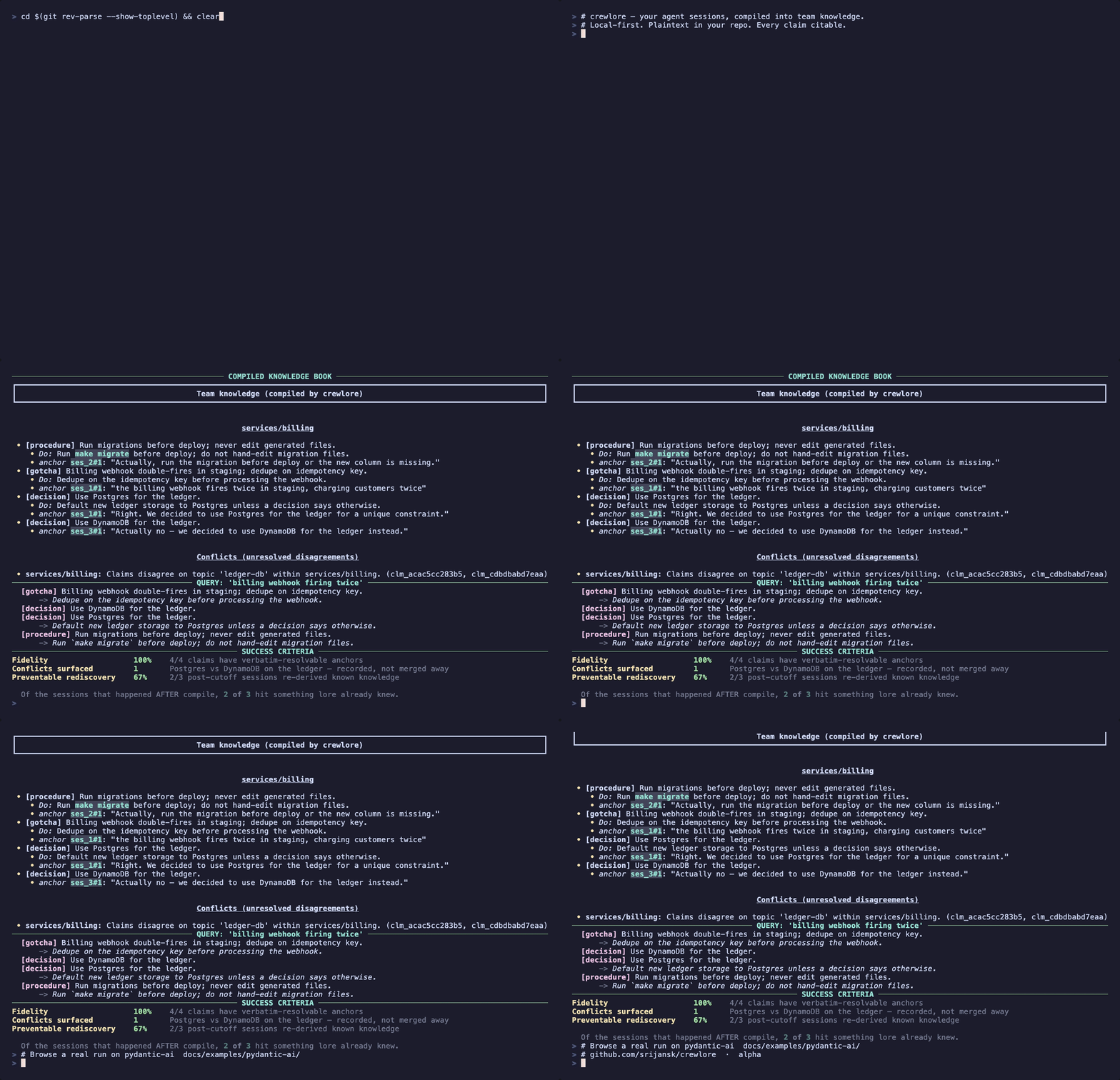
The demo runs the full loop on bundled public-safe sessions and prints what it found:
Note
Fidelity — 100%. Every claim's citation resolves verbatim back to its source. Conflicts surfaced — 1. A real disagreement kept with both provenances, not silently merged. Preventable rediscovery — 2 of 3. Two of the three held-out follow-up sessions re-derived knowledge the layer already had. (Illustrative demo data — n=3, not a benchmark.)
docs/examples/pydantic-ai/ is a committed snapshot of crewlore compiled on the public pydantic/pydantic-ai repo — 3 Claude Code sessions on real issues, no synthetic data.
- 18 claims compiled across 9 scope groupings (UI adapters, decorator introspection, durable-execution threat modeling, toolsets, tests, version policy)
- 100% fidelity under the explicit canonical-form contract — every anchor's quote canonically resolves to a substring of its source session. (Fidelity certifies the citation is real, not that the model's statement is fully entailed by it — that's what human/PR review of the book is for.)
- 0 conflicts because the three sessions covered disjoint scopes — the conflict detector wasn't given anything to flag
- Receipts: the rendered
book.md, the rawclaims.jsonl, and fullprovenance.md(session ids, commit hashes, compile cost, scrub redactions, five real-data bugs the capture surfaced and we fixed before publishing)
Raw, messy sessions go in. Out comes a structured, citable compiled claim — every one carrying its kind, its scope, the action it implies for future work, and a verbatim anchor back to the moment it was discovered:
[gotcha]· services/billingBilling webhook handler lacks an idempotency check, causing duplicate charges when Stripe retries webhooks.
Do — dedupe on the Stripe idempotency key before processing.
anchor — "the handler has no idempotency check, so when Stripe retries a webhook the charge is processed again."
A human can verify it (the anchor points back to the exact session line); an agent can trust it (the citation is real, not hallucinated). Claims roll up into a knowledge book at .lore/knowledge/README.md, grouped by area and committed to your repo alongside your code:
# Team knowledge (compiled by crewlore)

## services/billing

- **[gotcha]** Billing webhook handler lacks an idempotency check; dedupe on the Stripe key.
  - *Do:* Dedupe on the Stripe idempotency key before processing.
  - _anchor_ `ses_1#1`: "the handler has no idempotency check, so when Stripe retries a webhook the charge is processed again."

## deployment

- **[procedure]** Run migrations before deploy to prevent missing columns.
- *Do:* Run `make migrate` before every deploy.flowchart LR
S["coding agent<br/>sessions"] --> I["ingest + scrub<br/>(transcripts → NSF,<br/>secrets redacted)"]
I --> C["compile<br/>(NSF → claims,<br/>verbatim anchors)"]
C --> R["<b>.lore/</b> in your repo<br/>(knowledge book + claims,<br/>plaintext, git-versioned)"]
R --> SV["serve<br/>(files + MCP query)"]
SV --> N["next agent session<br/>inherits the knowledge"]
SV -. "usage signal" .-> AL["actuation loop<br/>(decay · reinforce · retire)"]
AL -. "lifecycle update" .-> R
classDef engine fill:#4a5d9e,stroke:#1a2c4d,color:#fff,stroke-width:2px
classDef artifact fill:#2d6a4f,stroke:#1b4332,color:#fff,stroke-width:2px
class C engine
class R artifact
lore watchruns ingest → compile → prune automatically, on an interval.
- Ingest + scrub — reads the coding agent's existing on-disk transcripts and redacts a curated set of secret patterns (Anthropic / OpenAI / generic
sk-*API keys, AWS keys, GitHub classic + fine-grained PATs, Google API keys, Slack tokens, HuggingFace tokens, JWTs, connection-string passwords, private-key blocks, andpassword=…assignment shapes) before anything is stored or sent to a model. The pattern set is documented indocs/scrub.md. - Compile — extracts atomic claims, deduplicates them, records disagreements instead of silently overwriting, scores authority by how often a claim recurs, and drops any claim whose citation doesn't resolve verbatim.
- Serve — writes a human- and agent-readable knowledge book to
.lore/knowledge/, and exposes a query tool (including an optional MCP server) so any agent can pull the relevant slice on demand. - Actuation loop — every retrieval is recorded, and that usage drives a lifecycle: unused claims decay and archive, contradicted claims are retired, useful claims are reinforced. The store stays small and fresh instead of growing into a pile nobody reads.
The intelligence is in compile; ingest and serve are deliberately thin, so supporting another coding agent is a small adapter, not a rewrite. To be precise about the word "compile": extraction is an LLM step (the only non-deterministic part), wrapped in deterministic stages — verbatim-anchor verification, content-addressed dedup, conflict recording, and authority scoring. "Compile" means the repeatable session → claims transform, not that an LLM is absent.
- vs. hosted memory (Letta, mem0) — their store lives in someone else's cloud and you can't
git logit;crewlore's lives in your repo as plaintext. - vs. per-IDE memory (Cursor rules, Claude memory, Continue, Cody) — tied to one developer, one IDE;
crewloreis a team artifact, committed and reviewed like code. - vs. hand-curated
CLAUDE.md/.cursorrules— humans write those by hand and they go stale;crewlorecompiles + reinforces from real sessions and retires what stops being used. - vs. RAG over a vector DB — RAG retrieves document chunks;
crewlorecompiles atomic, citable claims with verbatim anchors, so a human or agent can verify the cited source in seconds. (Retrieval today is deterministic lexical overlap, not embeddings — simpler and dependency-free; semantic ranking is on the roadmap.)
Knowledge discovered inside an agent session is private by default and lost by default. It lives in one developer's transcript, so the next engineer — and every future agent run — re-reads the same files, re-learns the same gotcha, and re-makes a decision the team already made. There's no shared layer that both humans and agents read from, so decisions drift and bugs resurface.
crewlore makes that knowledge a first-class, versioned artifact in the place your team already trusts: your git repo.
What it is: a compiler that turns sessions into accurate, deduplicated, conflict-aware, provenance-carrying team knowledge, served back to any agent.
What it isn't: a hosted service, a vector database, or a personal-memory layer for a single IDE. There's no account, no cloud, and no proprietary store — the compiled knowledge is plaintext you own.
- Local-first. Capture, compile, and serve all run on infrastructure you control. Point the compiler at your own model provider or a local OpenAI-compatible model (Ollama, LM Studio, vLLM) via
provider: local— nothing routes through anycrewlore-operated service, because there is none. - Plaintext, in your repo. The knowledge layer is human-readable Markdown and JSONL under
.lore/, versioned by git.git log .lore/is your audit trail. - Secrets never travel. Scrubbing — of both message content and tool-call arguments — happens at ingest, before storage or any model call. It's a high-precision pattern set (a floor, not a DLP guarantee; see
docs/scrub.md), and raw session captures are git-ignored by default regardless.
| Command | What it does |
|---|---|
lore init |
Create the .lore/ layout in your repo. |
lore watch |
Automatically ingest → compile → prune on an interval (--once for cron/CI). |
lore compile |
Run a single ingest-and-compile pass manually. |
lore query "<task>" |
Retrieve the claims most relevant to a task (records usage). |
lore status |
Show claim/conflict counts and how much of the layer is actually being used. |
lore serve --mcp |
Start an MCP server exposing query-time retrieval to any MCP-speaking agent (Claude Desktop, Cursor, …). Requires pip install 'crewlore[serve]'. See docs/mcp.md for wiring snippets. |
.lore/config.yaml:
model:
  provider: anthropic          # anthropic | openai | local
  name: claude-sonnet-4-6
  # For provider: local — point at any OpenAI-compatible endpoint you run:
  # base_url: http://localhost:11434/v1   # e.g. Ollama, LM Studio, vLLM
capture:
  transcripts: ~/.claude/projects
compile:
  cadence: auto                # `lore watch` interval below
  watch_interval_seconds: 300
Bring your own key (ANTHROPIC_API_KEY / OPENAI_API_KEY); crewlore never ships keys anywhere. The default Anthropic provider works out of the box. For OpenAI or a local OpenAI-compatible model, add the SDK: pipx inject crewlore openai (or pip install 'crewlore[openai]'). With provider: local nothing leaves your machine at all — the compile call hits your own endpoint.
Note
Status: alpha. The core is stable and tested end to end. The on-disk schema may change before 1.0 — and because everything is plaintext and git-versioned, breaking format changes will ship with migrations.
- Stable today: capture, secret scrubbing, the compile pipeline, retrieval, the actuation loop, and the
.lore/plaintext format. - In flight: cross-session conflict alignment — real disagreements are surfaced today, but reliably aligning claims about the same question across independently-compiled sessions is an active area of work.
- Planned: an explicit human approve-before-serve gate (secret scrubbing is already automated), more capture adapters beyond Claude Code, and a real-time capture hook.
Issues, discussions, and PRs welcome. New here? Start a discussion — adding a capture adapter for another coding agent is the most valuable first contribution and is intentionally small. See CONTRIBUTING.md for local setup and the dev loop.
Tests are fully deterministic — no real API calls during pytest.
MIT — see LICENSE.