


The command-line tool for Marlin-2B — a 2B video VLM for the two questions you actually ask a video: what is happening, and when. Runs free and local on Apple Silicon — no API key, no Hugging Face account.
marlin caption→ a Scene description + a<start>–<end>event timelinemarlin find→ locate when a query happens (supports auto-chunking for long videos)
Apple Silicon (M-series Mac) only for now. NVIDIA / other platforms are coming as a separate optimized build.
uv tool install nemostation      # 1. install   (or: pipx install nemostation)
marlin setup                     # 2. set up    (sign in, build engine, download weights)
marlin caption clip.mp4          # describe what's in a video
marlin find clip.mp4 "a deer crossing"   # locate when it happens → start → end
marlin find clip.mp4 "a deer crossing" --view # same as above but with a visualizer
Two commands and you're done — setup does everything: a one-time browser
sign-in (two questions, then Google), builds the local MLX engine, and downloads
the weights. After it finishes, caption and find just work. The 8-bit
weights are public — nothing gated, no API key. Add --json to any command
for parseable output, or --view to generate and open an interactive browser visualizer.
The engine stays warm between calls so responses are fast. To shut it down and
free the RAM (~16 GB): marlin stop. It auto-starts again on the next call.
marlin caption "video.mp4" — what's in it |
marlin find "video.mp4", "gunfight" — when it happens |
 |
 |
Each call runs one model pass on one bounded clip (~2 min at 2 fps) — the same
contract as the inference server. For longer videos, Marlin automatically
segments the input into overlapping ~30 s windows (5 s overlap by default,
tunable via --chunk-seconds / --overlap), grounds each chunk independently,
and merges the spans back to global timestamps.
Clips are auto-downscaled to the model's ~200K-pixel budget before inference
(faster, far less memory, no accuracy loss) — tune with --max-pixels (lower on
weak machines) or --full-res to opt out.
ffmpeg / ffprobe are required for long-video chunking (clip extraction) and
for auto-downscaling. A single short clip that needs no downscaling runs without
them.
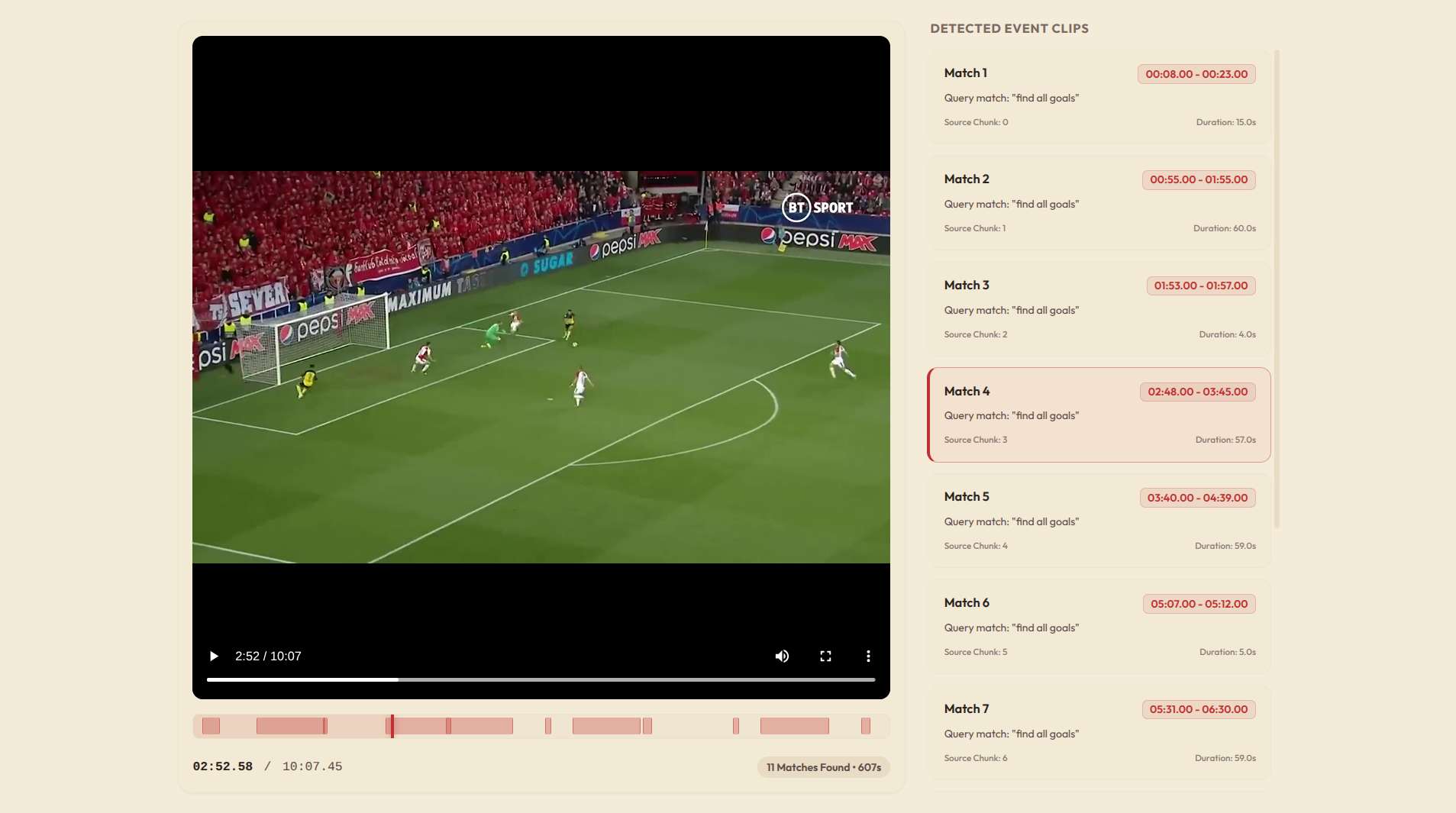
By adding the --view flag to either find or caption, Marlin compiles the detected events into a self-contained HTML dashboard and opens it in your default browser.
At 2B params it's the strongest open model in its weight class on dense captioning (DREAM-1K, CaReBench) and natural-language temporal grounding (TimeLens-Bench) — competitive with Gemini-2.5 at a fraction of the cost. See the benchmarks on the model card.
marlin skills install # → .claude/skills/ + .agents/skills/Installs the video-understanding skill so Claude Code / Codex use marlin as
"eyes on a video" — clip-length and single-find limits baked in. Every verb
honors --json (stdout parseable, progress on stderr).
Marlin is meant to be extended — and adding a skill is the easiest way in. A
skill is a folder under skills/
with a SKILL.md that teaches an agent to use caption / find for one job —
clip scoring, b-roll search, highlight reels, footage catalogs, whatever you build.
skills/
  video-understanding/SKILL.md   # ships today — the reference
  your-skill/SKILL.md            # ← add yours
Add one:
- Copy the format from
video-understanding/SKILL.md— frontmatter (name,description,requires.bins) + a short recipe. - Keep it honest about the limits (one bounded clip per call;
findreturns one span). - Open a PR. New skill ideas, issues, and docs fixes are all welcome too.
Hack on the CLI:
git clone https://github.com/shu-bamma/marlin-cli
cd marlin-cli
uv tool install --editable .     # or: pip install -e .
pytest                           # contract tests
New verbs, engine support, and bug fixes are all fair game — open an issue to chat about anything bigger. Licensed under Apache-2.0.
- Try it live → vlm.nemostation.com
- Model card + benchmarks → huggingface.co/NemoStation/Marlin-2B
- Team / custom fine-tuning → nemostation.com