A live intelligence tool that tracks, classifies, and compares open-source work published by government organisations on GitHub worldwide. The nightly pipeline fetches repos, classifies them using a Gemini-powered AI agent, embeds them for similarity search, and clusters them to surface duplicate efforts across countries. A natural-language query agent lets you interrogate the entire dataset through conversation.
🔗 Live app → govscan.streamlit.app
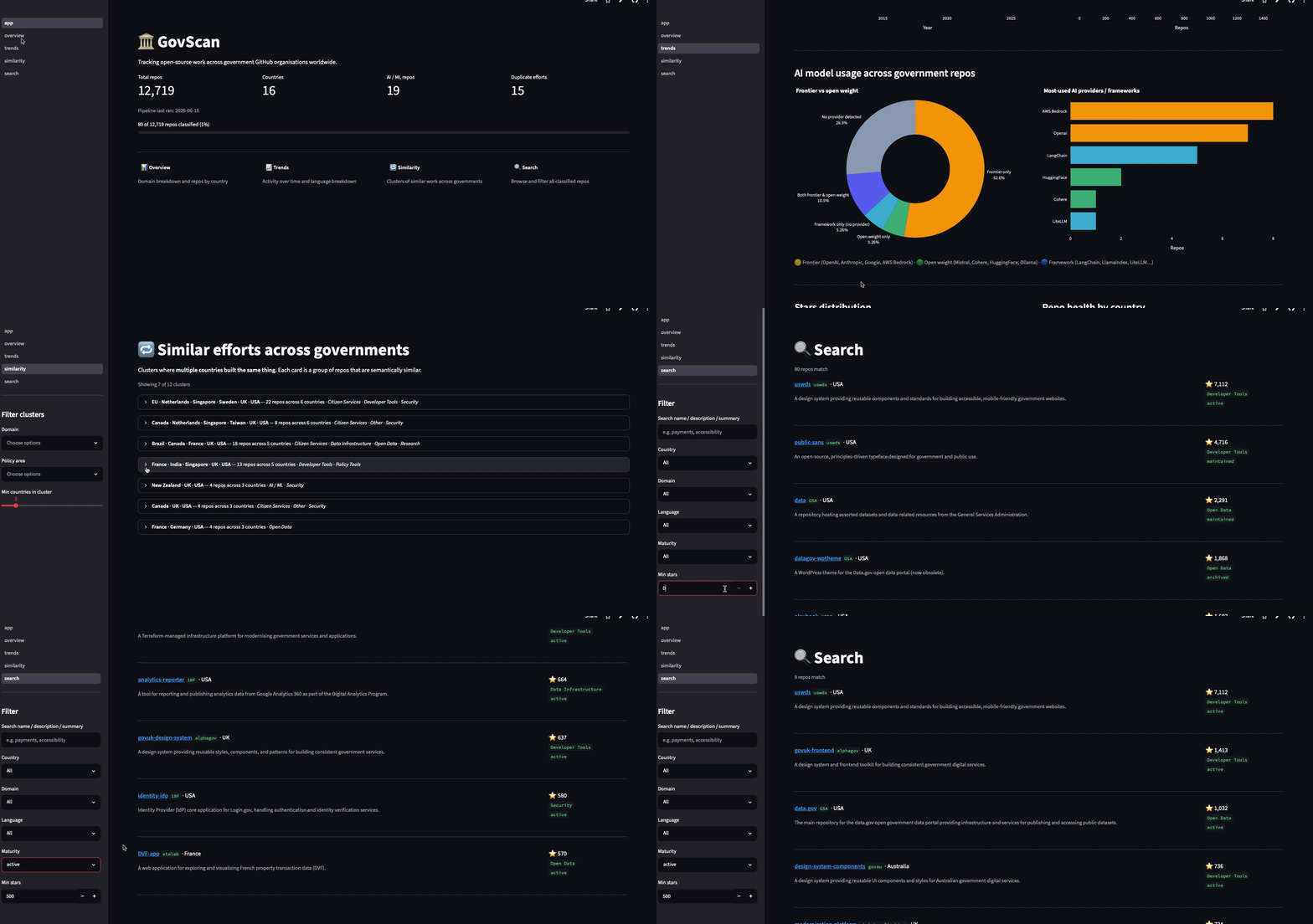
- Classifies every government repo by domain (AI/ML, citizen services, open data, security, etc.), policy area, and maturity using a Gemini agent — two-step reasoning: metadata first, README fetch if confidence is low
- Answers natural-language questions about government tech trends via a Gemini-powered query agent with SQL and similarity-search tools
- Detects AI model usage by scanning dependency files — distinguishes frontier models (OpenAI, Anthropic, AWS Bedrock) from open weight (Mistral, HuggingFace, Ollama)
- Clusters similar repos across governments to find where multiple countries built the same thing independently
- Tracks 12,700+ repos from 36 government organisations across 16 countries, updated nightly
| Page | Description |
|---|---|
| Overview | Domain breakdown, repos by country |
| Trends | Repos over time, top languages, AI frontier vs open weight usage |
| Similarity | Expandable cluster cards — countries, repo links, LLM summaries, domain filters |
| Search | Full-text search across name / description / LLM summary with sidebar filters |
| Ask | Natural-language chat agent — ask questions, get data-backed answers |
GitHub REST API
      │
      ▼
pipeline/fetch.py        ← paginated org scraping, rate-limit handling
      │
      ▼
pipeline/store.py        ← SQLite (repos, embeddings, clusters, ai_providers)
      │
      ├── pipeline/classify.py   ← Gemini agent → domain / maturity / policy_area
      │                             (2-step: metadata first; fetches README if confidence < 0.65)
      │
      ├── pipeline/embed.py      ← fastembed (BAAI/bge-small-en-v1.5, local ONNX)
      │
      ├── pipeline/cluster.py    ← KMeans on embeddings → cluster_id
      │
      └── pipeline/detect.py     ← scan requirements.txt / package.json for AI SDKs
                                    tier as frontier / open weight / frameworks

data/govscan.db          ← committed to repo nightly by CI
      │
      ▼
Streamlit multipage app  ← reads DB; Ask page also calls Gemini query agent at runtime
      │
      └── pipeline/query_agent.py ← Gemini 2.5 Flash + SQL tools → natural-language answers
The data pipeline is fully offline — all heavy processing runs in CI overnight. The Ask page is the only part that calls an LLM at runtime.
| Country | Organisations |
|---|---|
| UK | alphagov, i-dot-ai, co-cddo, nhsengland, DWPDigital, hmrc, ministryofjustice, ScottishGovernment |
| USA | GSA, 18F, uswds, CDCgov, USDS |
| France | betagouv, numerique-gouv, etalab |
| Canada | canada-ca, cds-snc |
| Singapore | govtechsg, opengovsg |
| Germany | digitalservicebund |
| Netherlands | minbzk, nl-design-system |
| Australia | AusDTO, govau, ServiceNSW |
| New Zealand | ServiceInnovationLab, GOVTNZ |
| Sweden | diggsweden |
| Denmark | digst |
| Estonia | e-gov |
| India | egovernments, mosip |
| Brazil | servicosgovbr |
| Taiwan | g0v |
| EU | ec-europa |
git clone https://github.com/plochockaa/govscan_streamlit
cd govscan_streamlit
uv sync                        # installs app deps only (streamlit, pandas, plotly)
uv sync --extra pipeline       # also installs pipeline deps (google-genai, fastembed, etc.)
Copy .env.example and fill in your tokens:
cp .env.example .env
# add GH_TOKEN and GEMINI_API_KEY
Run the app:
uv run streamlit run app.pyRun the full pipeline manually:
uv run python -m pipeline.runtest.yml— runs pytest on every push to mainpipeline.yml— nightly at 01:00 CEST: fetch → classify → embed → cluster → detect AI providers, then commits the updateddata/govscan.dbback to the repo, which triggers a Streamlit Cloud redeploy automatically
Secrets required in GitHub repo settings: GEMINI_API_KEY, GH_TOKEN (for reading public repos past the unauthenticated rate limit).


