

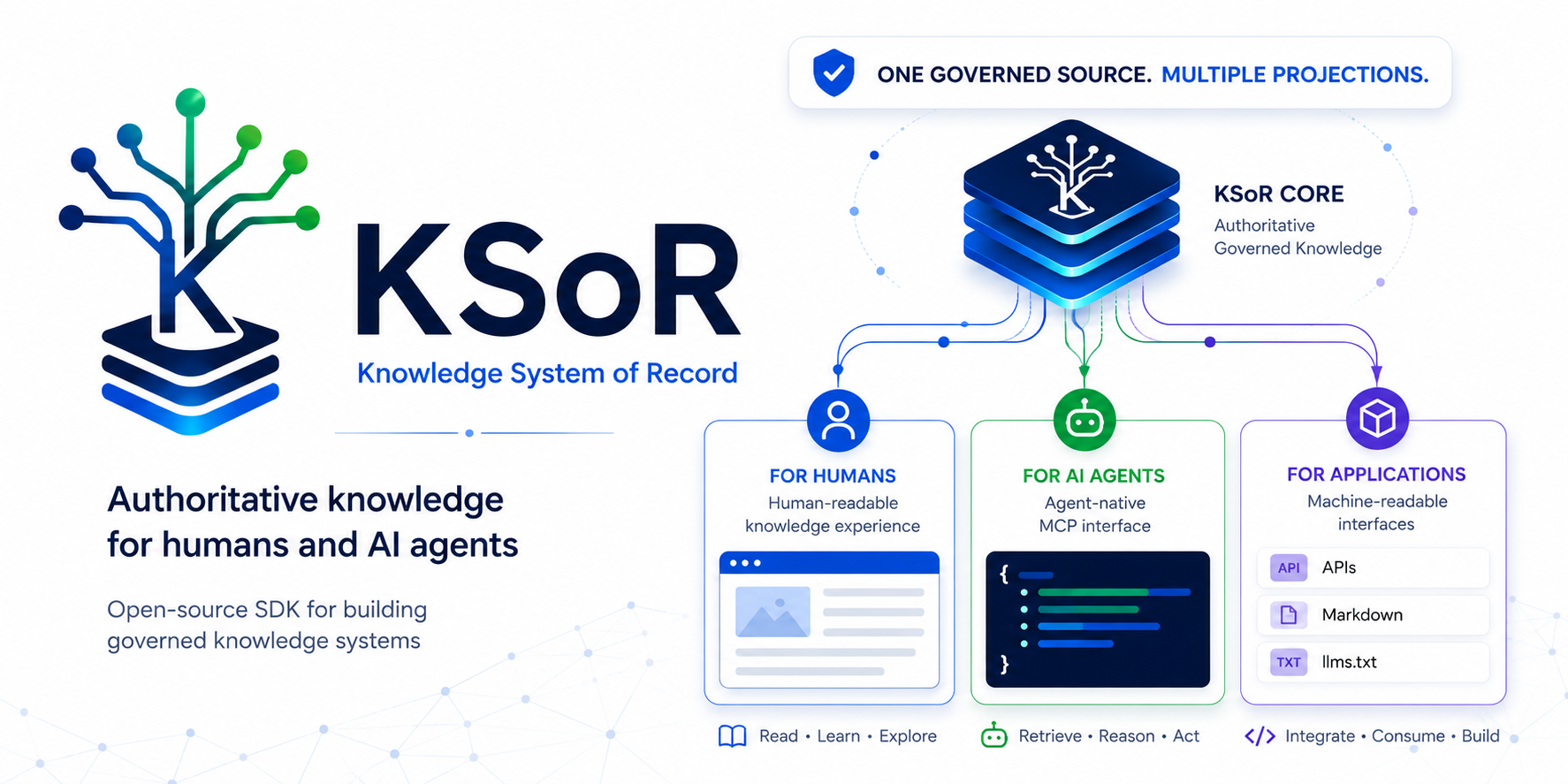
The authoritative knowledge infrastructure for AI-native organizations.
A Knowledge System of Record (KSoR) turns an organization's governed knowledge into infrastructure that humans, AI agents, and software can reliably operate from.
Traditional Systems of Record establish what is true about the current state of a business. A KSoR establishes what the organization knows and how it should operate.
Write and govern that knowledge once. KSoR makes the same institutional truth available through multiple synchronized projections:
- a human experience for reading, learning, reviewing, and sharing,
- an agent interface through MCP for search, retrieval, citation, reasoning, and action,
- machine-readable representations such as governed Markdown and
llms.txt, and - an agent-first maintenance context that helps coding agents validate, evolve, test, and publish the record.
All derive from the same authoritative source.
The result is not merely a documentation site, knowledge base, vector database, RAG system, or MCP wrapper.
KSoR is knowledge infrastructure for the AI-native organization.
⚠️ Early-stage software —docs/status.mdis the authority on what works.
ksor initis implemented: one command scaffolds a complete governed knowledge project — the record, a working site, and the agent kit. The remaining verbs (dev,build,serve) are designed, not implemented; running them prints an honest notice and exits 2. Inside a scaffolded project,pnpm devandpnpm buildwork today without them.
npx @panaversity/ksor init my-knowledge-sor
cd my-knowledge-sor

pnpm install
pnpm dev
The site serves your governed record at http://localhost:3000, hot-reloading
as you edit knowledge/.
Enterprises have relied on Systems of Record for decades.
An accounting system is authoritative for financial transactions. A CRM is authoritative for customer records. An HRIS is authoritative for employee records.
When a spreadsheet disagrees with the accounting ledger, the ledger wins.
These systems answer an important question:
What is the authoritative operational state of the business?
AI agents introduce a second problem.
Agents also need to know:
- What policies apply?
- What rules govern this decision?
- Which procedure should be followed?
- What does this organization mean by this term?
- Which thresholds are approved?
- Which methodology should be used?
- What exceptions exist?
- What sources support this answer?
- What should the agent do when the answer is not known?
That knowledge is usually fragmented across:
- documents,
- wikis,
- PDFs,
- slide decks,
- websites,
- policies,
- manuals,
- repositories,
- employee experience,
- prompts,
- RAG indexes,
- and model context.
There is often no authoritative answer to:
Which knowledge should the AI trust?
KSoR exists to solve that problem.
A Knowledge System of Record — KSoR — is the authoritative, governed knowledge layer that humans, AI agents, and software use to understand, decide, and act.
It can contain:
- domain knowledge,
- policies,
- procedures,
- rules,
- standards,
- methods,
- definitions,
- decision criteria,
- thresholds,
- specifications,
- controls,
- examples,
- exceptions,
- workflows,
- provenance,
- and supporting source material.
The goal is not merely to make information searchable.
The goal is to establish:
This is the knowledge we operate from.
A traditional System of Record and a Knowledge System of Record solve different problems.
| Traditional System of Record | Knowledge System of Record | |
|---|---|---|
| Primary purpose | Record operational state | Record institutional knowledge |
| Typical contents | Transactions, balances, customers, employees, inventory | Rules, policies, methods, procedures, standards, definitions |
| Typical systems | ERP, CRM, HRIS, accounting system | KSoR |
| Core question | What is true right now? | What do we know and how should we operate? |
| Optimized for | Applications and business processes | Humans, AI agents, and software |
| Authority | Operational data | Governed knowledge |
| Change mechanism | Transactions | Review, governance, versioning |
| AI role | Tool consumer | First-class knowledge consumer |
AI-native organizations need both.
                         AI Agent
                            │
             ┌──────────────┴──────────────┐
             │                             │
             ▼                             ▼
     Knowledge System                Traditional
       of Record                       Systems
        (KSoR)                        of Record
             │                             │
       "How should I                  "What is true
         operate?"                     right now?"
             │                             │
      Rules · Policies            Customers · Orders
      Methods · Standards         Balances · Inventory
      Procedures · Specs          Transactions · State
A capable enterprise agent may read policy from a KSoR, retrieve current account data from a CRM, apply the governed rule, execute an action, and record the resulting state back into the traditional SoR.
A knowledge base stores information.
A KSoR establishes authority.
That distinction matters.
A conventional knowledge base may optimize for:
- storage,
- search,
- retrieval,
- similarity,
- document discovery,
- or question answering.
A Knowledge System of Record must additionally answer:
- Who owns this knowledge?
- Where did it come from?
- Which version is authoritative?
- Has it been reviewed?
- What is its scope?
- What happens when sources conflict?
- Can an AI distinguish evidence from inference?
- Can an answer be traced back to its source?
- What should happen when the KSoR does not contain the answer?
KSoR therefore treats governance, provenance, citations, versioning, and abstention as architectural concerns rather than optional features.
KSoR may use search, indexing, embeddings, full-text retrieval, structured lookup, or other retrieval techniques.
Those mechanisms are implementation details.
KSoR is not fundamentally:
- a vector database,
- an embedding service,
- a RAG framework,
- a chatbot,
- a document search engine,
- or an MCP wrapper.
Those technologies can help deliver a KSoR.
They do not make something a KSoR.
The defining property is authoritative governed knowledge.
KSoR follows a simple principle:
Humans, AI agents, and software should not operate from different versions of organizational knowledge.
The governed record is the authority. Human, agent, and machine-facing experiences are projections of that record rather than separately maintained knowledge stores.
                         Governed Knowledge
                              Markdown
                                 │
                                 ▼
                            ┌─────────┐
                            │  KSoR   │
                            └────┬────┘
                                 │
          ┌──────────────────────┼──────────────────────┐
          │                      │                      │
          ▼                      ▼                      ▼
   Human Projection       Agent Projection      Machine Projection
   Next.js + Fumadocs          MCP              Markdown / llms.txt
          │                      │                      │
   Search / Browse        Search / Retrieve       Consume / Index
   Read / Learn           Cite / Reason           Integrate / Build
   Review / Share         Abstain / Act                 │
          │                      │                      │
          └──────────────────────┼──────────────────────┘
                                 │
                              Same Truth
A KSoR can also carry an agent-first maintenance context — for example AGENTS.md and reusable skills — so coding agents can work on the governed record without turning their own model context into a competing source of truth.
The human experience is not maintained as a separate knowledge source.
The MCP interface is not an invisible copy of the website.
Machine-readable outputs are not a third knowledge store.
They are different projections of the same governed source.
Knowledge should have one canonical location.
Different consumers may receive different representations, but those representations must derive from the same source.
Knowledge architecture can no longer assume that only people will read documentation.
Every important piece of institutional knowledge should be usable by:
- humans,
- AI assistants,
- autonomous agents,
- agent workflows,
- applications,
- and machine-readable tooling.
Different consumers may require different representations, but those representations should derive from the same governed record.
An answer is much more useful when you can determine:
- what document it came from,
- which version was used,
- when it was built,
- and what source supported the claim.
KSoR preserves the chain from source knowledge to generated projections.
An AI sounding confident is not evidence.
KSoR is designed around traceable answers.
The agent should be able to identify the knowledge that supports its answer rather than relying on model memory.
A governed AI system needs to know the boundary of its knowledge.
When the KSoR does not contain enough information to support an answer, the correct behavior is:
The Knowledge System of Record does not contain enough information to answer this.
—not improvisation.
Retrieval technology is not the hard part.
A perfectly optimized search system over ungoverned knowledge simply retrieves ungoverned knowledge faster.
The more important questions are:
- What belongs in the KSoR?
- Who can change it?
- What constitutes an authoritative source?
- How are conflicts resolved?
- How are changes reviewed?
- What is obsolete?
- What requires human judgment?
KSoR treats those questions as fundamental.
Your institutional knowledge should not belong to an AI model vendor.
KSoR keeps the knowledge layer independent from the model layer.
The same governed knowledge should be usable from:
- ChatGPT,
- Claude,
- coding agents,
- agent frameworks,
- custom applications,
- Digital FTEs,
- and future AI runtimes.
Models can change.
Your institutional truth should remain yours.
KSoR is intentionally not limited to a particular industry or type of knowledge.
Examples:
Agent Factory KSoR
Engineering KSoR
Product Management KSoR
Company Operations KSoR
Security KSoR
AI Governance KSoR
Examples:
Accounting KSoR
Government Contracting KSoR
Healthcare KSoR
Legal KSoR
Banking KSoR
Insurance KSoR
Supply Chain KSoR
Sales KSoR
Examples:
Design System KSoR
API Standards KSoR
Architecture KSoR
Implementation Method KSoR
Compliance Framework KSoR
Operating Model KSoR
The SDK does not impose verticality.
A Vertical KSoR is simply one application of KSoR: an authoritative knowledge layer for a particular profession, industry, or domain.
Imagine an Accounting KSoR containing:
knowledge/
├── accounting-policies/
│   ├── revenue-recognition.md
│   ├── capitalization.md
│   └── bad-debt.md
├── procedures/
│   ├── month-end-close.md
│   └── journal-entry-review.md
├── controls/
│   ├── segregation-of-duties.md
│   └── approval-thresholds.md
├── definitions/
│   └── glossary.md
└── examples/
    └── revenue-recognition-examples.md
An employee can browse those documents through the generated website.
An accounting agent can access the same governed knowledge through MCP.
If asked:
Can this $42,000 software implementation cost be capitalized?
the agent should retrieve the organization's capitalization policy, apply the relevant criteria, cite the governing source, and distinguish between what the KSoR states and any reasoning required to apply it.
If the capitalization policy does not address the situation, the system should not invent a policy.
Status:
ksor initworks. Thedev,build, andserveverbs are designed, not yet implemented — each prints an honest notice and exits2today; the scaffold's ownpnpm dev/pnpm buildcover local work until they land.docs/status.mdis authoritative.
Node.js 24 or newer, and pnpm (npm install -g pnpm, or corepack enable pnpm on Node versions that bundle corepack).
node --versionnpx @panaversity/ksor init my-ksor
cd my-ksorOne command emits a complete governed project: the knowledge record, a working documentation site, adopter CI, and the instructions and skills a coding agent needs to work in it. Nothing else is downloaded — the scaffold is deterministic, offline, and entirely yours.
pnpm install
pnpm dev
The local knowledge site serves at http://localhost:3000 and hot-reloads as
you edit the Markdown source — the same governed corpus that will ultimately
serve humans, agents, and machine-readable consumers.
pnpm buildA fully static export of the human surface lands in system/site/out/,
deployable to any static host. (ksor build — validation plus build
provenance — is a future verb; see docs/status.md.)
npx @panaversity/ksor serveThe agent projection will expose the governed KSoR through MCP. This verb is
designed, not implemented — the prose you write in your scaffold's
instance.md is reserved as its future system prompt.
A KSoR project is intentionally understandable without proprietary tooling.
A scaffolded project looks like:
my-ksor/
│
├── knowledge/            ← the record: governed CommonMark, the product
│   ├── example.md
│   ├── policies/
│   │   ├── policy-a.md
│   │   └── policy-b.md
│   └── procedures/
│       └── procedure-a.md
│
├── system/
│   └── site/             ← the reference site (Next.js + Fumadocs)
│
├── .agents/
│   └── skills/           ← agent skills (+ byte-identical .claude/ copies)
│
├── AGENTS.md             ← the project constitution agents read first
├── instance.md           ← what this KSoR is authoritative for
│
└── ...
The authoritative knowledge corpus.
Documents are plain Markdown so they are:
- portable,
- diffable,
- reviewable,
- version-controlled,
- readable by humans,
- readable by AI coding agents,
- and independent of a proprietary database.
Subdirectories naturally organize the knowledge hierarchy.
Describes the identity and purpose of this KSoR instance.
For example:
# Accounting KSoR

This Knowledge System of Record contains the governed accounting
policies, procedures, definitions, controls, and decision criteria
used by Example Corporation.The reference human projection — a real Next.js + Fumadocs app that renders the
record, shipped as ordinary source code you own outright rather than an
opaque hosted service. It is replaceable behind a five-clause surface
contract (specs/ksor/init/spec.md): any shell that renders the record,
degrades directives to readable text, serves llms.txt, passes the browser
smoke, and never emits a document outside the audience it was built for is
equally conformant.
The reference site also exposes machine-readable output such as llms.txt.
That output is another projection of the same governed record, not a separately
maintained AI corpus.
Instructions and reusable skills for AI coding agents working on the KSoR.
KSoR is designed to be agent-first.
The agent-maintenance context is not itself authoritative knowledge. It tells coding agents how to work on the authoritative record safely.
Instead of forcing users to manually perform repetitive repository operations, the project can carry the instructions an AI coding agent needs for recurring tasks such as:
- adding knowledge,
- importing source material,
- validating structure,
- creating learning material,
- checking provenance,
- building,
- testing,
- and deployment.
KSoR treats institutional knowledge increasingly like software teams treat source code.
That means knowledge can be:
authored
   ↓
reviewed
   ↓
version controlled
   ↓
validated
   ↓
tested
   ↓
built
   ↓
published
   ↓
consumed by humans + agents
Git becomes more than storage.
It provides useful primitives for knowledge governance:
- history,
- authorship,
- diffs,
- branches,
- pull requests,
- approvals,
- releases,
- rollback,
- and reproducible builds.
This makes an important shift possible:
Institutional knowledge becomes governed infrastructure.
Every production answer should be traceable to the knowledge that produced it.
KSoR builds record the exact corpus used to produce a release.
For example:
build.lock.json
can capture information such as:
- included documents,
- document hashes,
- source commit,
- KSoR version,
- build version,
- and other reproducibility metadata.
This creates a chain:
AI Answer
    ↓
Retrieved Passage
    ↓
Knowledge Document
    ↓
KSoR Build
    ↓
Git Commit
    ↓
Reviewed Source
When someone asks:
Why did the agent say that?
the architecture should make the answer discoverable.
KSoR uses the Model Context Protocol (MCP) as the reference interoperability boundary between governed knowledge and AI runtimes.
MCP is an interface to the KSoR, not the KSoR itself.
The goal is not to create another model-specific knowledge plugin.
Instead:
                      KSoR
                       │
                      MCP
                       │
        ┌──────────────┼──────────────┐
        │              │              │
        ▼              ▼              ▼
     ChatGPT         Claude       AI Agents
                                      │
                           ┌──────────┼──────────┐
                           ▼          ▼          ▼
                        Custom     Agent      Digital
                         Apps    Frameworks     FTEs
The knowledge stays independent.
The model or runtime becomes replaceable.
AI-native systems increasingly need knowledge in forms that software can consume directly, without scraping a human documentation interface.
A KSoR can therefore expose representations such as:
- canonical governed Markdown,
llms.txt,- structured metadata,
- build manifests,
- indexes,
- and other machine-readable artifacts.
These outputs are derived from the same governed record. They do not become independent sources of truth.
The durable asset remains the governed knowledge; each representation is replaceable.
RAG answers:
How can relevant information be retrieved and placed into model context?
KSoR answers a broader question:
What knowledge is authoritative enough that an organization permits humans, AI agents, and software to operate from it?
A useful relationship is:
KSoR
│
├── Governance
├── Authority
├── Provenance
├── Versioning
├── Review
├── Scope
├── Human Projection
├── Agent Projection
├── Machine Projection
├── Agent-First Maintenance Context
│
└── Retrieval
     ├── Search
     ├── Structured lookup
     ├── Embeddings
     └── RAG
RAG can be part of a KSoR.
A KSoR is not merely a RAG system.
A Content Management System asks:
How do we create and publish content?
A KSoR asks:
Which knowledge is authoritative, governed, traceable, and safe for humans, agents, and software to rely upon?
Content is an input.
Institutional knowledge is the asset.
Authority is the differentiator.
A production KSoR should make knowledge ownership explicit.
A simple governance lifecycle might be:
Source
  │
  ▼
Draft
  │
  ▼
Review
  │
  ▼
Approved
  │
  ▼
Authoritative KSoR
  │
  ├──────────────► Human Projection
  │
  ├──────────────► Agent Projection
  │
  └──────────────► Machine Projection
  │
  ▼
Superseded / Retired
Organizations can impose additional controls appropriate to their domain.
For regulated or high-risk knowledge, those controls may include:
- named knowledge owners,
- approval requirements,
- effective dates,
- source citations,
- mandatory review periods,
- change records,
- conflict resolution,
- separation of duties,
- and audit history.
KSoR provides the architectural foundation; governance policy remains the responsibility of the organization operating the KSoR.
A trustworthy KSoR has a boundary.
The existence of an AI model does not remove that boundary.
Consider three questions:
What approval threshold applies to purchases over $50,000?
If an approved purchasing policy answers the question, KSoR should provide the answer and source.
Does this particular purchase require CFO approval?
The system may need to combine the governed rule with operational facts from another System of Record.
What approval policy will the company adopt next year?
If that information has not been approved and entered into the KSoR, the system should decline rather than speculate.
This distinction is essential for trustworthy agentic systems.
An AI-native organization cannot rely on model memory, scattered documents, or an ungoverned RAG index as its institutional knowledge layer.
KSoR becomes especially important when AI agents begin performing real organizational work because it gives humans, agents, and software a shared, governed basis for interpretation and action.
                   Human / AI Worker
                          │
                          ▼
                       Agent
                          │
             ┌────────────┴────────────┐
             │                         │
             ▼                         ▼
           KSoR                 Operational SoRs
             │                         │
        Knowledge                  Current State
             │                         │
     Policies / Methods          CRM / ERP / HRIS
     Rules / Procedures          Ledger / Database
     Standards / Specs           Orders / Inventory
             │                         │
             └────────────┬────────────┘
                          │
                          ▼
                       Decision
                          │
                          ▼
                        Action
The KSoR tells the agent how the organization operates.
Traditional Systems of Record tell the agent what is currently true.
Together they provide the context required for reliable enterprise action.
KSoR is designed for a development world in which coding agents perform much of the mechanical work.
A scaffolded KSoR can carry machine-readable instructions for tasks such as:
"Add this policy to the KSoR."

"Convert these source documents into governed Markdown."

"Check every page for missing provenance."

"Build a quiz from this section."

"Validate the KSoR."

"Run the test suite."

"Prepare this release."

"Deploy the human surface."
The repository therefore becomes both:
- the knowledge artifact, and
- the working context for the agents that maintain it.
This allows subject-matter experts and software engineers to collaborate around the same governed source.
KSoR does not require organizational knowledge to disappear into a vector database.
The canonical source remains inspectable.
A person should be able to:
- open it,
- read it,
- diff it,
- review it,
- copy it,
- migrate it,
- and understand what the AI is being allowed to use.
This is an intentional architectural property.
Your KSoR should survive changes in:
- LLM providers,
- embedding models,
- vector stores,
- agent frameworks,
- cloud providers,
- AI applications,
- and user interfaces.
The durable asset is the governed knowledge.
Everything around it should be replaceable.
The human surface generated by pnpm build in a scaffolded project (and by
ksor build once that verb ships) is a fully static site.
That makes it suitable for hosts such as:
- Vercel,
- Netlify,
- GitHub Pages,
- static object storage,
- internal web servers,
- nginx,
- and private infrastructure.
Before production deployment, configure the canonical site URL in the site configuration.
Detailed deployment guidance can live with each generated project so the instructions remain version-aligned with the KSoR release being used.
A Knowledge System of Record frequently contains internal organizational knowledge.
KSoR therefore aims to support architectures in which:
- the knowledge remains under organizational control,
- the website can be self-hosted,
- external runtime dependencies are minimized,
- and the agent interface can be deployed inside the organization's security boundary.
A KSoR should not require an organization to publish its institutional knowledge to a third-party SaaS platform simply to make it usable by AI.
Agent Factory illustrates the transition KSoR is designed to support: from a human-readable book plus retrieval service toward an AI-native knowledge platform where humans and AI agents learn, reason, and operate from the same governed source of truth.
The Agent Factory KSoR can define the shared methodology used across many AI-native implementations:
Agent Factory KSoR
├── architecture
├── principles
├── FDE methodology
├── governance
├── agent patterns
├── evaluation standards
├── implementation methods
└── operating model
It acts as a shared methodological System of Record.
A Vertical KSoR captures knowledge specific to a profession or industry.
For example:
Government Contract Accounting KSoR
├── accounting rules
├── FAR requirements
├── contract structures
├── indirect rates
├── revenue recognition
├── billing procedures
├── compliance controls
├── workflows
└── decision criteria
Agents can combine the Agent Factory KSoR with the appropriate Vertical KSoR when performing domain work.
              Agent Factory KSoR
                  Shared Method
                       │
                       │
                       ▼
                    AI Agent
                       ▲
                       │
                       │
                  Vertical KSoR
                  Domain Truth
Both can be built using the same ksor SDK.
KSoR is complementary to existing enterprise systems.
It does not replace:
- your CRM,
- ERP,
- accounting system,
- HRIS,
- transactional database,
- data warehouse,
- lakehouse,
- document source systems,
- or operational APIs.
Those systems remain authoritative for their respective operational state.
KSoR adds the authoritative knowledge layer agents need in order to understand how to interpret that state and what to do with it.
KSoR is being designed around the following goals.
There should be a clear canonical source.
Knowledge should have ownership and controlled change.
Important answers should lead back to evidence.
Humans must be able to see what agents are reading.
Knowledge should not be trapped inside one vendor.
AI agents must be able to consume the corpus programmatically.
People must be able to browse and understand the same knowledge.
Changes to institutional truth should have history.
A deployed KSoR should be traceable to a particular corpus and version.
Multiple KSoRs should be usable together.
Organizations should be able to adapt the framework to their requirements.
KSoR is under active development.
The project is evolving from the original VSOR implementation into the more general Knowledge System of Record architecture.
The predecessor (vsor) implementation — reference material for this rebuild, not its authority — already proved out several foundations that inform this package's design, including:
- Markdown-based authoritative source content,
- generated human-readable documentation sites,
- project scaffolding,
- local development,
- static builds,
- build provenance,
- agent-oriented repository instructions,
- automated testing,
- and deployment workflows.
The MCP-based agent projection is designed, not implemented — see docs/status.md.
See:
CHANGELOG.md— what has shippeddocs/status.md— current implementation statusCONTRIBUTING.md— contributingSECURITY.md— security policy
Do not infer production readiness of a capability from this conceptual README alone. The status document and released package version are authoritative for implemented functionality.
The intended CLI vocabulary is deliberately small:
ksor init
ksor dev
ksor build
ksor serveCreate a new Knowledge System of Record.
ksor init accounting-ksorRun the human surface locally with development tooling.
ksor devValidate and build the deployable KSoR projections.
ksor buildExpose the agent-readable KSoR interface.
ksor serveThe installed release's help will list the commands it supports:
ksor --helpThe canonical npm package is:
@panaversity/ksor
The unscoped name ksor is blocked by npm's similarity guard, so the package is
scoped. The command installed by it is still ksor.
Install it:
npm install @panaversity/ksorInstall globally:
npm install -g @panaversity/ksorOr execute without a global installation:
npx @panaversity/ksorContributions are welcome.
Before contributing, read:
AGENTS.md
docs/status.md
CONTRIBUTING.md
The project is intentionally agent-friendly, so coding agents should also read AGENTS.md before making changes.
The development gate is defined in CONTRIBUTING.md:
lint, format check, typecheck, guard invariants, corpus checks, unit and
integration tests, build, and publint. Browser and deployment acceptance will
join it when a site surface exists.
Do not weaken provenance, abstention, governance, or reproducibility guarantees merely to simplify an implementation.
Those are part of the product.
Knowledge Systems of Record can contain sensitive institutional information and can influence AI agent behavior.
Treat security issues involving the following as particularly important:
- unauthorized corpus access,
- provenance bypass,
- malicious source ingestion,
- prompt injection through knowledge content,
- privilege escalation,
- unsafe MCP exposure,
- build tampering,
- dependency compromise,
- and the ability to make ungoverned knowledge appear authoritative.
See SECURITY.md for reporting instructions.
KSoR is licensed under the Apache License 2.0.
A traditional System of Record tells an AI system what is true about the business; a Knowledge System of Record tells humans, agents, and software what the organization knows and how it should operate.
KSoR makes that knowledge authoritative, governed, traceable, human-readable, agent-readable, machine-readable, and vendor-neutral.
Govern knowledge once. Let humans and AI operate from the same truth.