A personal AI agent system built on top of coding agents.
Renamed from y-cli. y-cli wrapped model APIs; y-agent wraps coding agents.
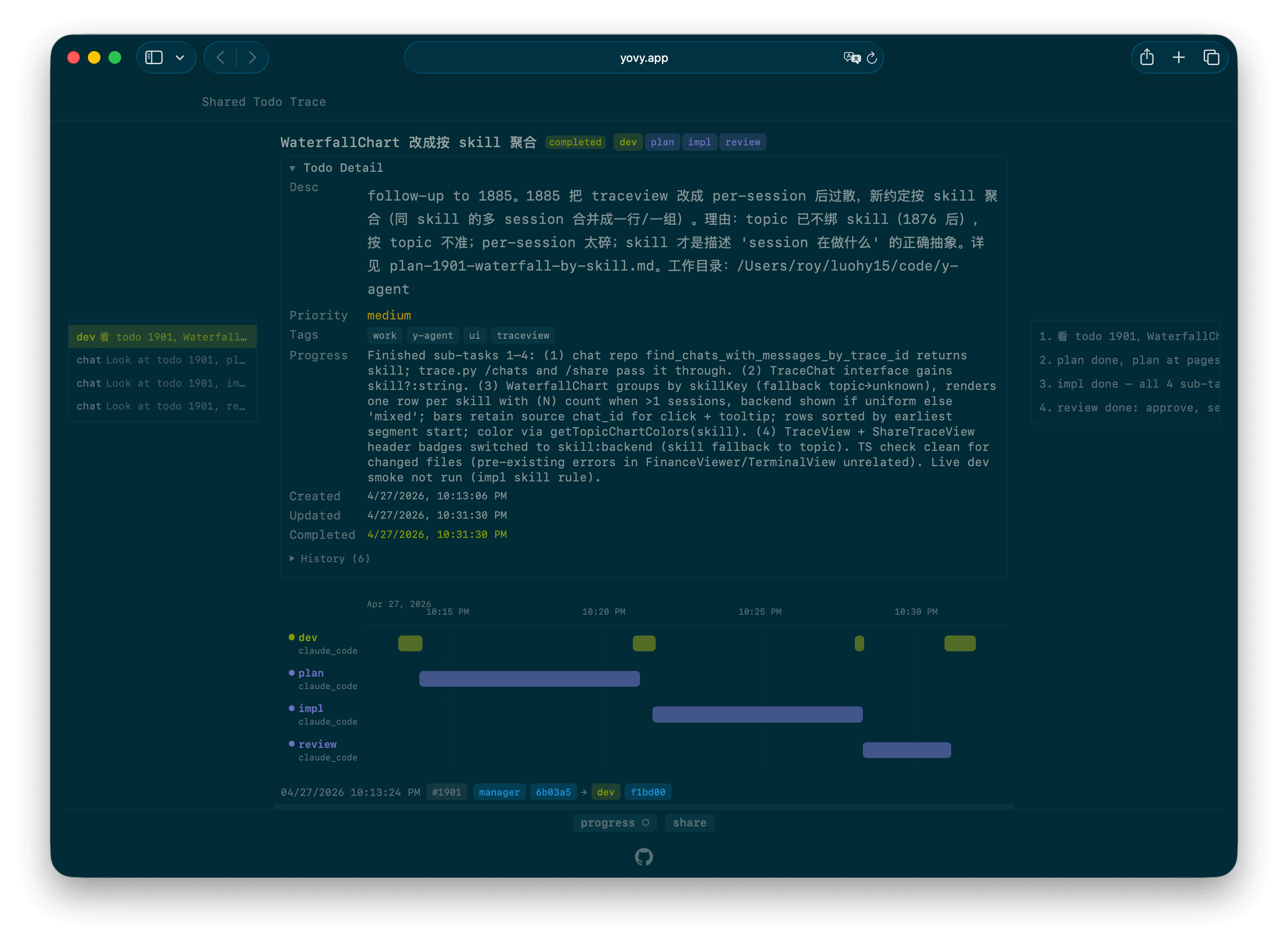
A real trace: https://yovy.app/t/6fc5c4
Web chat renders inline artifacts from assistant messages: Mermaid diagrams, Vega-Lite charts, and sanitized artifact-svg blocks.
Coding agents like Claude Code / Codex are great for code, but code is only part of my daily life. I also have ledgers, calendars, todos, notes, emails. I want the agent to handle those too.
Three things came up while extending a coding agent into a personal agent system:
- How to give the agent context
- How to keep the agent always-on
- How to orchestrate multiple agents
Same data for me and for the agent. Files go through read / write / edit. Anything I'd reach for a GUI to do, the agent reaches for a CLI — it's already happy in Bash. Rule: whatever I can do in the GUI, the agent can do via CLI. The underlying file or DB row is the same.
I don't want to carry a laptop or open a terminal to use it. Coding agents run on a remote VM (EC2) inside tmux; a tail process parses their output into the database, so the web UI can chat with them directly. A Telegram bot covers mobile input. EC2 auto-hibernates when idle, so cost is near zero when nothing is running.
One session usually can't handle the whole thing — requests have to be routed to the right session. Claude Code ships sub-agents, but I wanted that layer outside, so sub-agent chats stay in my own DB and I can steer them mid-run.
   user        ┌──────────────────┐
   input ────► │  skill: manager  │   dispatch only,
        │     └────────┬──────────┘   no execution
        │              │   y chat --skill dev -m "..."
        │              ▼
        │     ┌──────────────────┐
        ├───► │  skill: dev      │   coordinator,
        │     │                  │   runs lower-level skill sessions
        │     └──┬──────┬──────┬─┘
        │        │      │      │   y chat --skill {plan,impl,review}
        │        ▼      ▼      ▼
        │     ┌──────┐ ┌──────┐ ┌────────┐
        └───► │ plan │ │ impl │ │ review │   anonymous, ephemeral;
              └──────┘ └──────┘ └────────┘   skill loaded per dispatch
A trace_id (= todo_id when the task is tracked) threads the whole tree, so TraceView renders the chain as a waterfall.
Two paths, split by whether you run the server or just use one. Each page opens with a client or server tag so you always know which side you're on.
Client — use a hosted instance (y login against yovy.app and go; no infra needed):
- docs/getting-started.md — the web GUI after sign-in, built around the four showcased capabilities (todo & trace, note, link, finance).
- docs/cli.md — install the CLI, sign in, every command group.
- docs/capabilities.md — client + server reference: what a running deployment ships.
Server — self-host (you run the API + worker yourself):
- docs/self-host.md — prerequisites, install, run, deploy, config keys.
Longer write-up, design rationale, and comparisons: full blog post.
CHANGELOG tracks weekly updates.