






We build autonomous robots that compete on a game table — navigating, detecting objects, and completing missions with zero human input. Our platform, RaccoonOS, is a full custom stack running on the KIPR Wombat controller, from bare-metal firmware up to a visual programming environment.
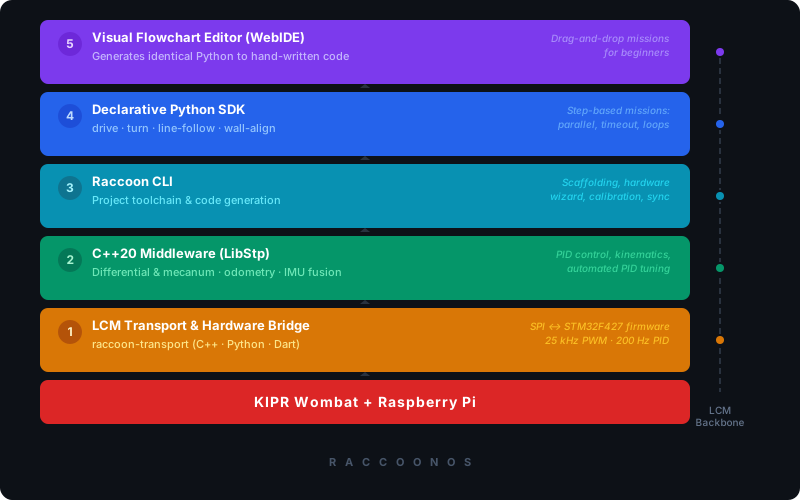
Five layers, one shared LCM communication backbone — no capability gaps between beginner and expert workflows.
📖 Full documentation at raccoon-docs.pages.dev
$ pip install raccoon-cli
$ raccoon create project MyRobot // creates a new project & starts the configuration wizard- New to the platform? Start with the Getting Started guide.
- Want a full working example? Clone
raccoon-example— a clean reference robot with every concept demonstrated and explained. - Just want to read the code? Start with
raccoon-lib— it's the core.
| Repository | Description | Tech | Build | Version |
|---|---|---|---|---|
| raccoon-lib | Core robotics library — PID control, kinematics, odometry, step-based missions |   |
 |
 |
| stm32-data-reader | Raspberry Pi ↔ STM32 SPI bridge, publishes sensor data via LCM | |
 |
 |
| raccoon-cli | Dev toolchain — scaffolding, hardware wizard, codegen, remote sync | |
 |
 |
| botui | StpVelox — Flutter desktop environment with real-time dashboard & sensor viz |  |
 |
 |
| WebIDE | Visual flowchart editor — drag-and-drop step programming that generates real Python |   |
||
| raccoon-transport | LCM-based inter-process messaging (C++, Python, Dart) |  |
 |
|
| raccoon-cam | Camera pipeline for object detection |  |
||
| raccoon-image | The repository having the build instructions + Flashable .img files |
| Repository | Description |
|---|---|
| raccoon-example | Clean reference robot — every concept (missions, servos, sensors, line following, custom steps) in one readable project. Start here if you're new. |
| Repository | Description | Build |
|---|---|---|
| documentation | Full platform docs — hosted here |  |
| Papers-and-Documentations | (PRIVATE) ECER conference papers and competition archive |
RaccoonOS grew out of Tobias Madlberger's years competing in Botball at HTL St. Pölten (2022–2026). What started as competition code went through multiple complete rewrites, slowly becoming a proper five-layer robotics platform - not by design, but by necessity.
The architecture, core libraries, firmware, and toolchain were all built from scratch, The platform was formally named RaccoonOS in September 2025.
On graduating in 2026, Tobias open-sourced everything — not just for future HTL teams, but for every Botball student who would otherwise face the same wall he hit in 2022: no documentation, no foundation, no starting point.
"Three years of figuring out what nobody wrote down - now it's written down."
| Name | Role |
|---|---|
| Tobias Madlberger | Founder & Lead Architect — platform design, middleware, firmware, toolchain, SDK, AI pipeline, WebIDE core, and everything in between (2022–2026, 1000+ hours) |
| Matthias Greil | Hardware & Firmware — STM32 implementation, IMU integration, low-level driver work; shaped the high-level SDK as a power user |
| Fabian Popov | AI & Visualization — object detection data labeling, game table visualization and simulation in the WebIDE |
| Jakob Schlögl | UI — BotUI development |
| Daniel Schneeweis | WebIDE — developed the web-based IDE |
| Florian Schwanzer | General Contributions — library work, sensor calibration, tests, and filling gaps wherever needed |
| Anna Theis | Early Adopter & Pre-Alpha Feedback — used the earliest bare-bones versions in real robot development, whose hands-on feedback shaped the foundation everything else grew from |
RaccoonOS is open to the wider Botball community.
- Bug reports & feature requests — open a GitHub issue in the relevant repo
- Code contributions — PRs welcome; see
CONTRIBUTING.mdin each repo - New teams — reach out to senior teams as they have the knowlegde and can help you - alternatively read the docs




St. Pölten, Austria · htlstp.ac.at
