




An open-source practice for trustworthy modeling — making the outputs of both AI systems and physical systems verifiable.
Embedding geometry to check what an LLM says · energy geometry to model how a physical system behaves.




Groundlens · Otwin · Featured · Research · About
Most AI and modeling failures are not failures of capability — they are failures of trust: a model produces an output, and nothing tells you whether to believe it. Groundlens builds the missing layer. It applies geometry to make outputs verifiable, with one consistent stance: deterministic where possible, calibrated where not, and clear about where the method stops working.
It ships as two open-source lines that share that DNA:
- Groundlens — verifies what a language model says, using the geometry of embeddings.
- Otwin — models how a physical system behaves, using the geometry of energy (port-Hamiltonian structure) with calibrated uncertainty.
Both are MIT-licensed, grounded in peer-reviewed research, and built to be auditable rather than impressive.

Geometric grounding and hallucination triage for production LLMs in regulated industries. It ranks responses by how faithfully they reflect their sources — deterministic scores, sub-second, no second LLM in the loop — so the ones that earned trust pass and the rest go to human review.

Run grounding verification in your browser — no install.


groundlens · grounding-benchmark · groundlens-mcp · Groundlens-Cookbook
The methods are not heuristics — they come from published work.
| Paper | Idea | Link |
|---|---|---|
| Semantic Grounding Index (SGI) | Ratio-based grounding verification for RAG — measures whether a response engages its source via angular geometry on the unit hypersphere. |  |
| A Geometric Taxonomy of Hallucinations | Three-type hallucination classification via directional grounding (von Mises–Fisher on displacement vectors); domain calibration reaches AUROC 0.76–0.99. |  |
| Rotational Dynamics of Factual Constraint Processing | Transformers reject wrong answers by rotating the representation, not rescaling — with a phase transition at ~1.6B parameters. |  |

Digital twins with calibrated uncertainty for grid-scale energy storage and other physical systems. You bring the physical model structure you know (a port-Hamiltonian system, or an empirical law); Otwin estimates the rest from data, attaches horizon-aware uncertainty intervals, and validates without leakage against mandatory baselines. Lightweight and CPU-first, spanning white-box (full physics) to grey-box (physics + estimated residual).


| Problem | Result |
|---|---|
| Water tank · first-principles (white-box). A draining tank written as a port-Hamiltonian system — can a structure-preserving forecast stay physical at any horizon? | 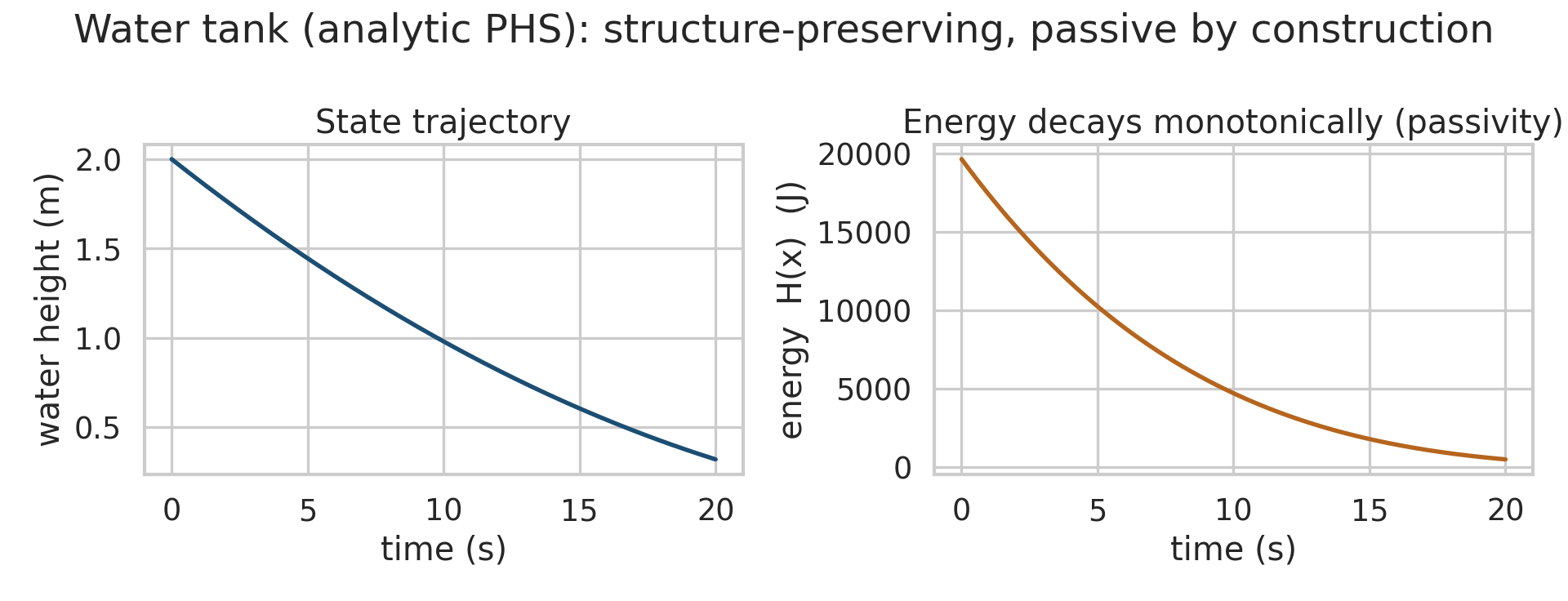 Energy decays monotonically (passive by construction); skill ≈ 0.94 vs a persistence baseline. |
| DC motor · first-principles, multi-domain. Coupled electrical + mechanical actuator — can the twin predict it with no fitting? | 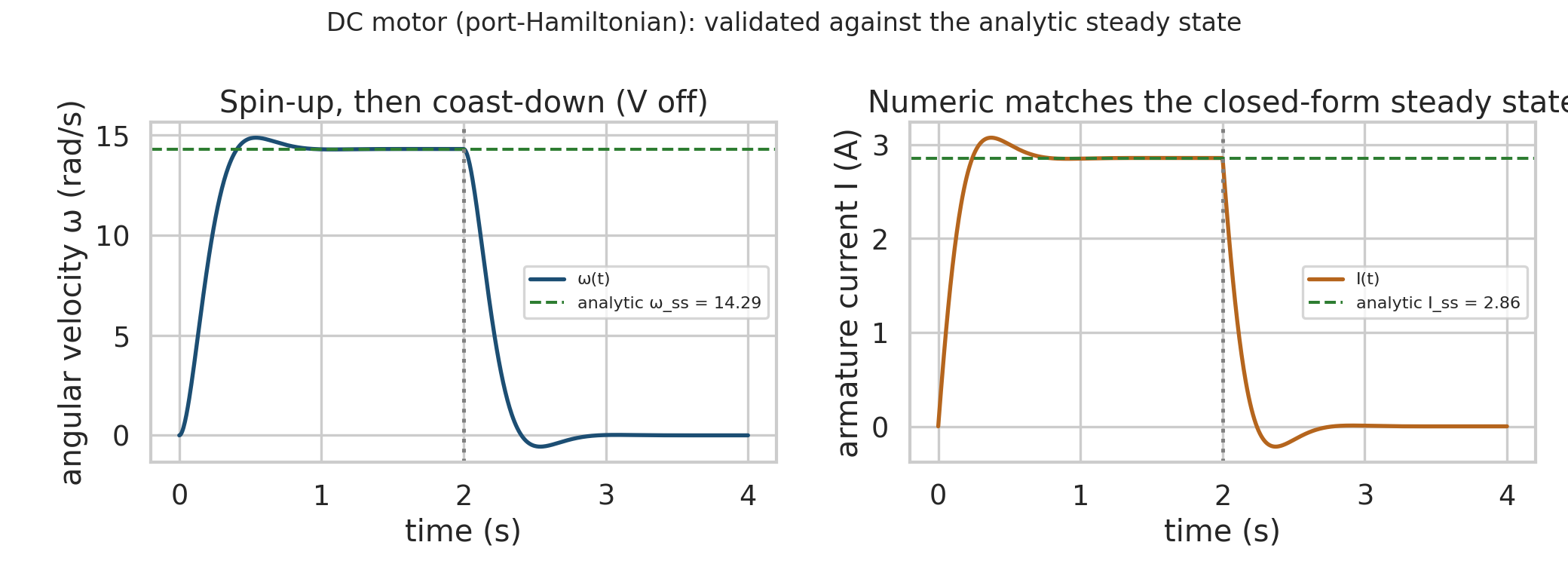 Numeric steady state matches the closed-form ω, I to within 0.001%. |
| Pumped-hydro storage · white-box, grid-scale. The dominant grid storage technology — how much energy survives a charge/discharge cycle? | 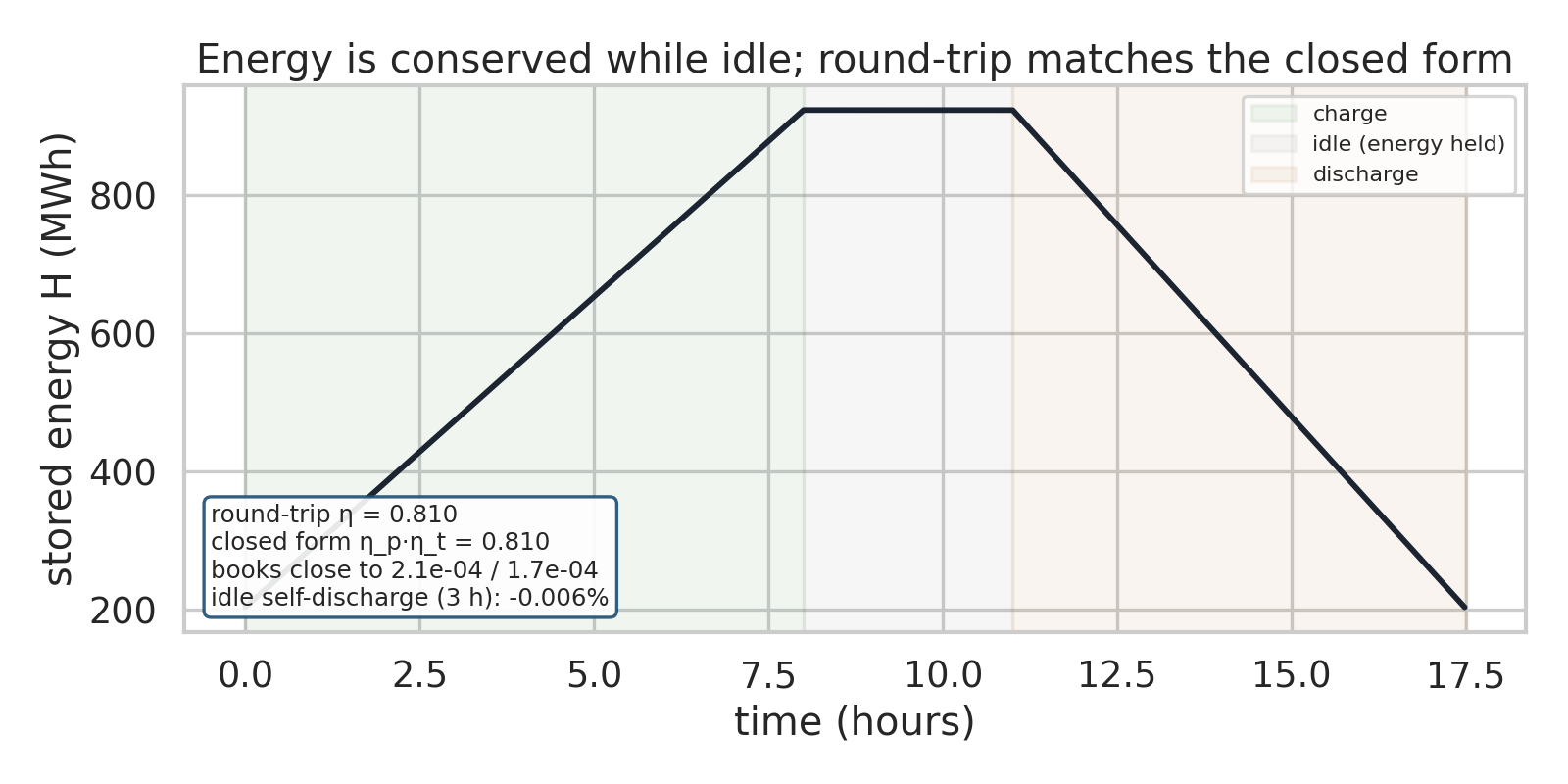 Round-trip efficiency matches the closed form ηp·ηt; energy conserved while idle. |
| Battery State-of-Health · grey-box. Forecast Li-ion SoH / remaining useful life with trustworthy intervals (predictive maintenance). | 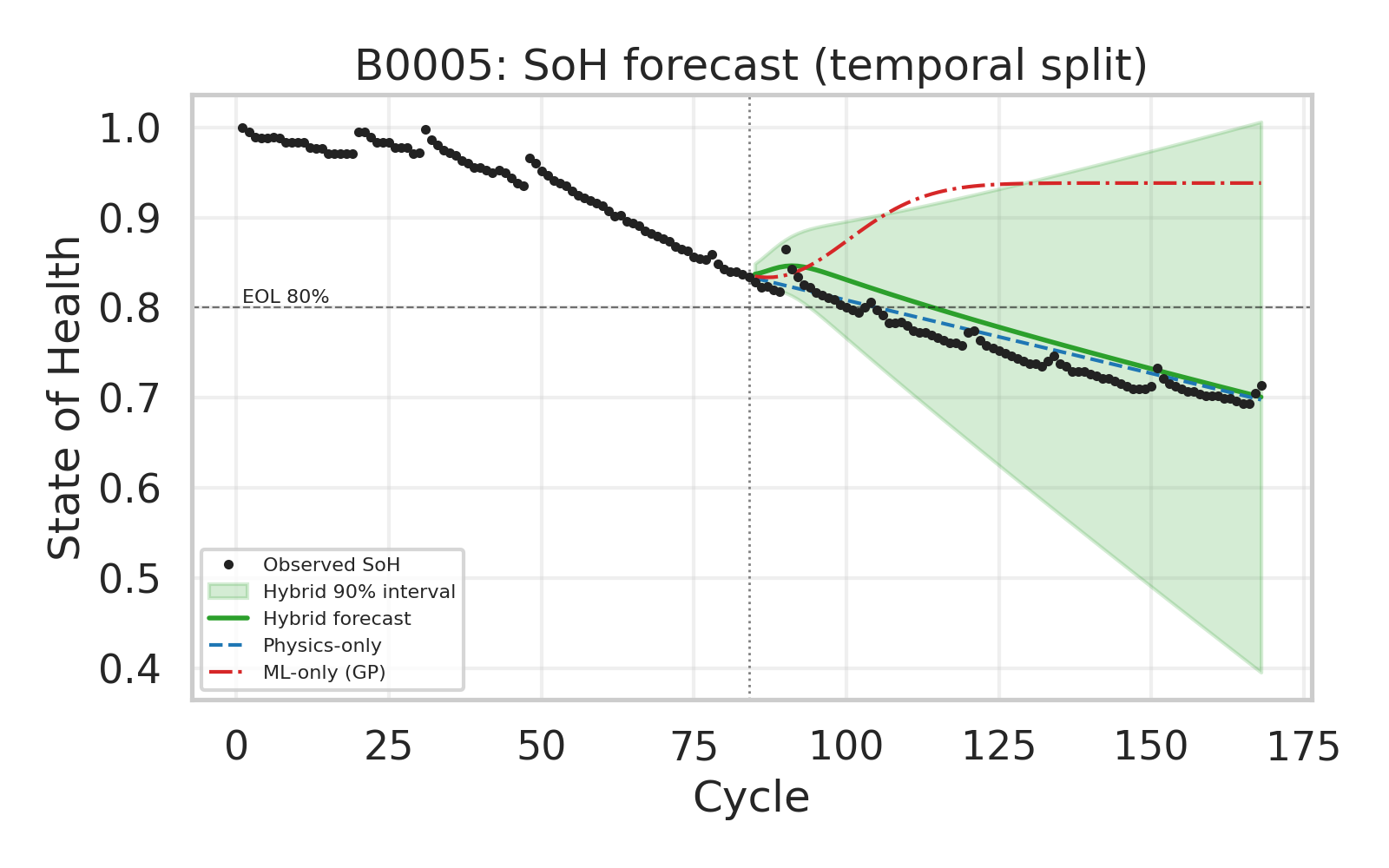 The physics-informed hybrid tracks the real decay to end-of-life; a data-only model diverges. The 90% band is calibrated. |
| Grid-scale dispatch · predictive maintenance → real-time optimization. Dispatch storage under uncertain capacity. | 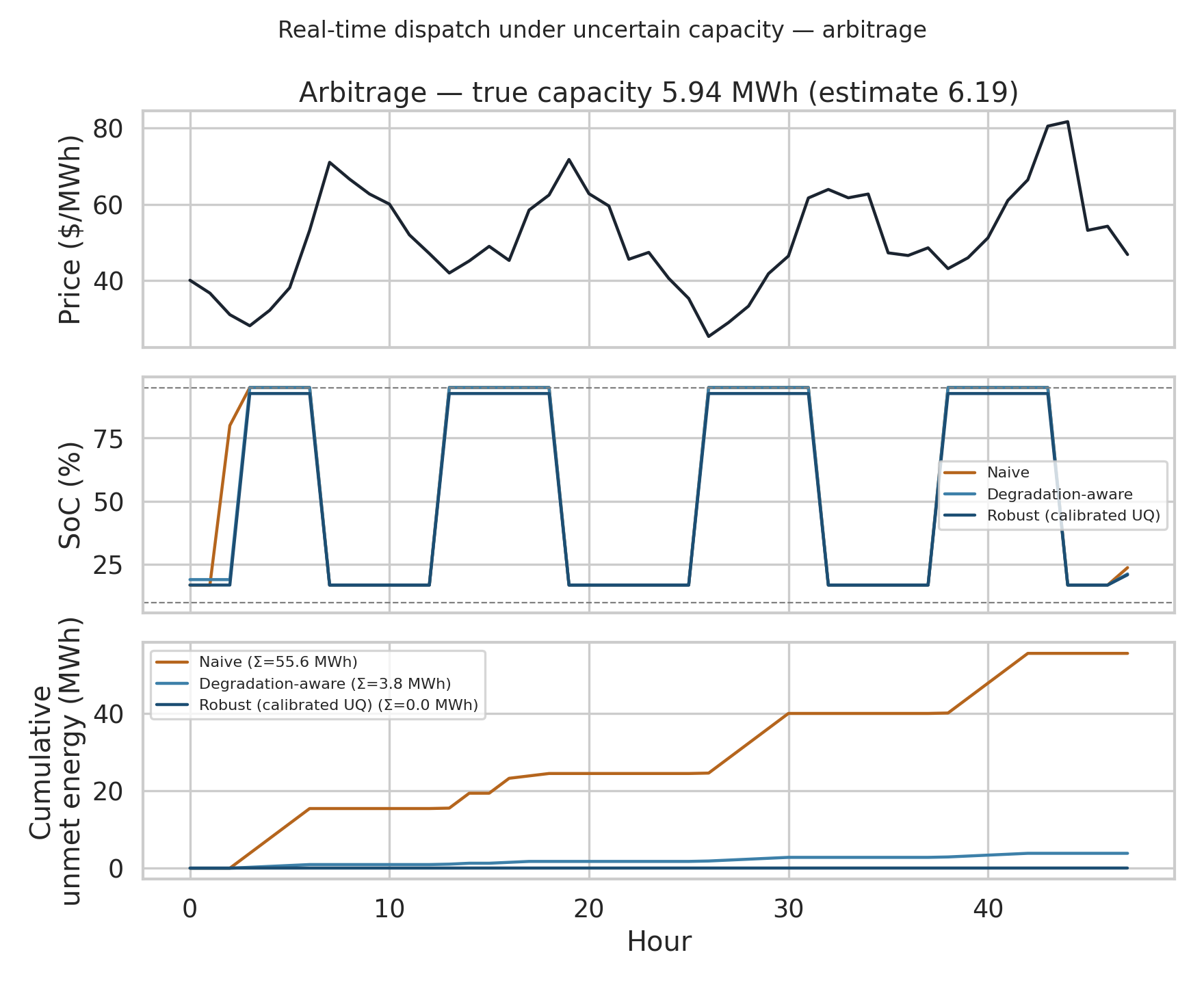 The calibrated-UQ plan leaves 0.0 MWh of demand unmet over the horizon, vs 55.6 MWh for a naive plan. |

100,000+ impressions · read it on LinkedIn
Groundlens is built on peer-reviewed research. Selected publications:
| Year | Publication | Venue / link |
|---|---|---|
| 2026 | Rotational Dynamics of Factual Constraint Processing | arXiv:2603.13259 |
| 2026 | A Geometric Taxonomy of Hallucinations | arXiv:2602.13224 |
| 2025 | Semantic Grounding Index (SGI) | arXiv:2512.13771 |
| — | Evaluating Synthetic Tabular Data Generated to Augment Small-Sample Datasets | see Scholar |
| — | Synthetic Tabular Data Generation | see Scholar |
| — | Explainable Deep Neural Networks | see Scholar |

Contributions are welcome across all Groundlens repositories. Please read CONTRIBUTING.md before opening an issue or pull request.
This community follows the Contributor Covenant. See CODE_OF_CONDUCT.md.
To report a vulnerability, please follow the process in SECURITY.md — do not open a public issue for security matters.
All Groundlens open-source projects are released under the MIT License. See LICENSE.
Groundlens is an independent open-source practice for trustworthy modeling, working at the intersection of applied geometry, physics, and machine learning. Its two lines — Groundlens (LLM verification) and Otwin (physics-informed digital twins) — share a single goal: outputs you can audit before they reach production.
Maintained by Javier Marin · Madrid · javier@groundlens.dev · groundlens.dev
Verification over capability.