

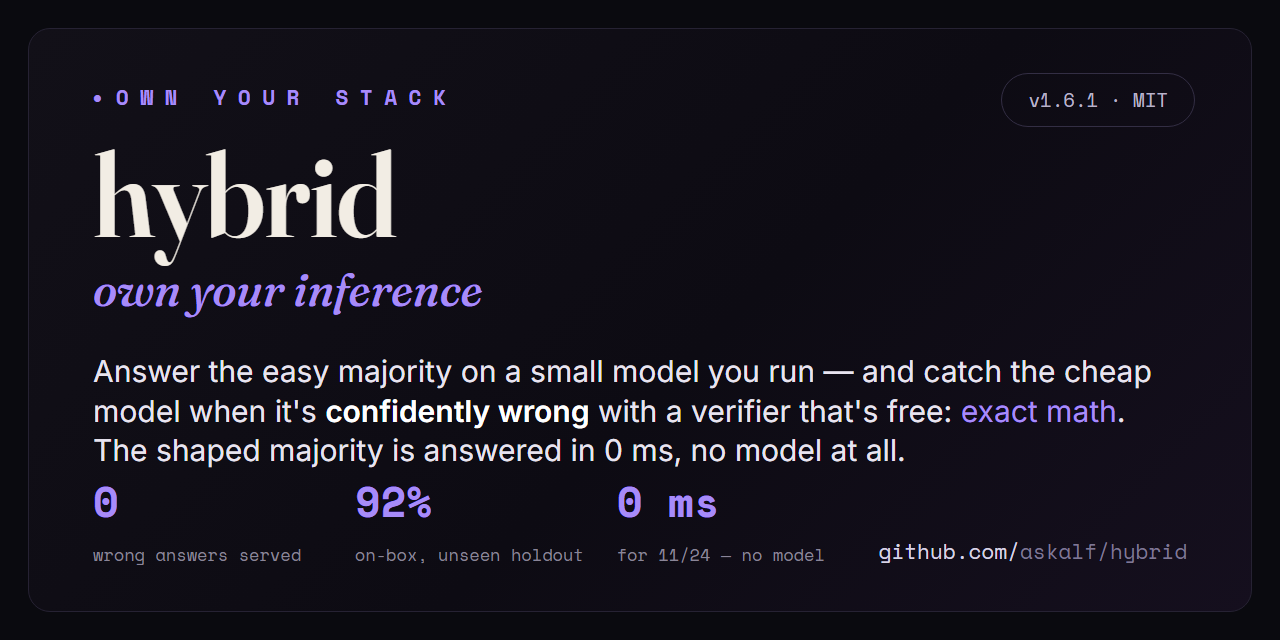
hybrid — own your inference. Part of Own Your Stack — own your AI infrastructure instead of renting it by the token.
Answer the easy majority of your LLM queries on your own machine — free, private, fast — and escalate only the genuinely hard ones to a frontier model. Most of what you ask an LLM is easy (facts, rewrites, simple Q&A, arithmetic); the rare hard query (a proof, real code, multi-step reasoning) goes to the frontier. Frontier quality where it matters; nothing paid or sent off your machine for the rest.
Dependency-free Python (stdlib only). Built and measured on a GPU-less 2013 desktop — the writeup, with all the numbers, is here: Your CPU isn't bad at LLMs — it's bandwidth-starved.
The hard part isn't routing the easy queries home — it's knowing when the cheap model is confidently wrong. A router built on the cheap model's own signals (classification, self-consistency) inherits its blind spots: it can't tell confident-and-right from confident-and-wrong. hybrid's answer is a free verifier that is stronger than the model — Python's exact arithmetic — applied at every depth it can reach: solve the closed forms outright, transcribe the shaped word problems deterministically, and re-derive the model's own working on everything else.
query → router ─┬─ solve:    arithmetic · unit conversion · %-change? ▶ SOLVED  (python, exact, free)
                ├─ template: a word-problem SHAPE we recognize outright
                │              (rate×qty · bat-and-ball pair · reverse-% ·
                │               shift · price mix)? deterministic
                │              transcription + closed form ──────────▶ SOLVED  (python, exact, free)
                ├─ rule:     hard category (code/proof/puzzle) ───────▶ ESCALATE
                ├─ rule:     open-ended (rewrite/summarize) ──────────▶ LOCAL
                ├─ derive:   quantitative? the model transcribes the
                │              problem's relationships as EQUATIONS;
                │              we solve the linear system ourselves,
                │              exactly ─▶ LOCAL if it re-derives the model's answer,
                │                         ESCALATE if it contradicts it
                ├─ verify:   not derivable? local answers + plugs its
                │              numbers into the problem's relationships;
                │              re-derive each exactly ─▶ LOCAL if every check holds,
                │                                        ESCALATE if any is false
                └─ vote:     local self-consistency ─▶ LOCAL if unanimous, else ESCALATE
- Deterministic solver (
solver.py) answers what a cheap model gets confidently wrong — closed-form arithmetic, plus exact unit conversions (3 miles → 15840 feet, via1 in = 25.4 mmwithFractions, never a float), percentage-change (20% off 50 → 40), and multiples (half of 60 → 30). Zero frontier calls, correct by construction. Strictly conservative — anything that doesn't reduce cleanly falls through. - Template transcriber (
templates.py, new in v1.5.0) — the derive tier's lesson, inverted. The model's real job on a word problem is transcription, and transcription is the one surface the exact oracle cannot check — so for the shapes that dominate everyday quantitative queries, don't ask the model at all. Five rigid shapes (rate × quantity/time, total + gap pairs, reverse-percentage, plain shifts, two-price mixes) are parsed deterministically and solved in closed form overFractions: zero tokens, zero latency, and the answer cannot be multiplied wrong — the confident-wrong-product class the verifier used to have to catch is simply answered, exactly, for free. Stricter than any other tier about declining: every number in the query must be consumed by the shape, number-words ("half", "twice") anywhere else decline, nouns must agree between declaration and question, and set-logic riddles never match. It even out-ranks the hard-category rule — a clean exact parse beats a stray keyword. - Category rules escalate domains a small model is known to fail (code, proofs, puzzles).
- Open-ended rules keep creative tasks (rewrite, summarize) local — no single right answer.
- Setup re-derivation (
equations.py, new in v1.1.0) — for any quantitative query (a digit, or two number-words: "a chicken and a half lays an egg and a half…"), the model transcribes the problem's relationships as equations over named unknowns — transcription is an easier skill than solving — and we solve the linear system ourselves, by exact Gaussian elimination overFractions. An answer its own transcription contradicts is a hard escalate (the model mis-solved its own setup); a re-derived match stays local in one call where self-consistency needs three. Runs before plug-back because a derivation produces its own value instead of grading the model's checks — so a tautology can't fool it (live: the 7B "verified" its wrong Sally's-sisters answer withCHECK: 3 + 3 - 1 = 5 / 2 * 2— true, and disconnected from the problem). Strictly conservative: nonlinear, inconsistent, or underdetermined systems fall through rather than guess. - Verify-the-local-answer (
verify.py) — when nothing was derivable, the local model answers and plugs its own numbers back into the problem's relationships, writing pure-numeric checks we re-derive exactly. A false check is a hard escalate (the answer is provably inconsistent with the problem); all-checks-hold stays local. Strictly stronger than self-consistency, which at temperature 0 just repeats the same wrong number. - Self-consistency for the rest: answer a few times — concurrently, so a batching
server (Ollama with
OLLAMA_NUM_PARALLEL≥ 3) streams the weights once for all samples and the vote costs about one sample's wall time; unanimous → keep local, else escalate.
The real router over a labeled mix — closed-form, conversions, shaped word problems, factual, off-template confident-wrong arithmetic, hard, and setup traps. Frontier escalation is stubbed, so the benchmark is free (measured live on an 8-core CPU box):
ON-BOX:        17/22 (77%) answered without a frontier call
ON-BOX SAFETY: 17/17 on-box answers correct        (ZERO wrong answers served)
TEMPLATE:      7/7 shaped word problems answered exact, zero model calls
CATCHES:       2/2 confident-wrong arithmetic intercepted -> escalated
ESCALATED:     5/22 routed to the frontier
HONEST LIMIT:  0 setup traps slipped through local + wrong
The line has moved three times now. v1.0.0: 15/20 on-box but 13/15 correct — both documented setup traps served locally and wrong. v1.1.0: zero wrong served — the setup re-derivation tier caught Sally's-sisters and solved chicken-and-a-half, trading on-box points for safety. v1.5.0 moves it again in the other direction: the shaped word problems — including the confident-wrong products the verifier used to have to intercept — are now answered exactly with zero model calls and zero latency, so the on-box rate goes back UP without giving back any safety. A few of the rows, verbatim:
SOLVED     How many feet in 3 miles?                  -> 15840    (exact, free)
SOLVED     1,847 widgets/day for 263 days             -> 485761   (template: rate — v1.1 had to CATCH the model flubbing this; now it is answered, exactly, in 0 ms)
SOLVED     bat and ball, bat $1 more                  -> 0.05     (template: sum-diff — the $0.10 trap answer is unproducible)
LOCAL      chicken-and-a-half                         -> 0.67     (setup re-derived)
ESCALATE   56 crates arrive, 3 damaged — units left?  -> caught: the extra quantity makes the template decline; the verifier catches the model's flubbed product
ESCALATE   Sally's-sisters                            -> caught: its own equations contradict its answer
On a fresh 24-query holdout (never seen by any tier — new numbers, new phrasings, new traps), the same build measured 22/24 on-box (92%) with 11/24 answered in 0 ms (solver + templates) and total wall time halved on the same box and mix (228 s → 106 s). The one wrong-served answer is the documented transcription-leak trap, which the templates correctly decline — the model-side limit is unchanged, just reached less often. Where a small model stays confidently wrong even when it reasons well is exactly where a free exact oracle wins — and the strongest form of winning is never asking it.
On-box query share and dollar share are not the same number. The queries that escalate
are the token-heavy ones — a proof, a code-gen — so routing saves less than the 75% on-box
rate suggests. measure_routing.py prices every query's frontier cost: escalations at what
they really cost, on-box answers at the counterfactual cost they avoided.
ON-BOX:               15/20 (75%) answered without a frontier call
$ SAVED:              ~52% of frontier spend avoided  (not 75%)
PER 1000 (this mix):  ~$2.86 all-frontier  ->  ~$1.37 hybrid
Three-quarters of queries stay home, but only about half the dollars: escalation
correctly sends the few token-expensive hard problems to the frontier — which is the whole
point, and the reason query-share overstates the savings. Measured against claude-sonnet-4-6
list pricing ($3 / $15 per 1M); set PRICE_IN_PER_M / PRICE_OUT_PER_M for your own frontier.
pipx install hybrid-router       # console commands: hybrid, hybrid-server
# or: pip install hybrid-router
# or straight from the repo: pipx install git+https://github.com/askalf/hybrid
Zero runtime dependencies — the wheel is the six modules you can read above, installed
exactly as they read. Published to PyPI from CI on every release via Trusted
Publishing (OIDC — no tokens anywhere). hybrid --version tells you what you got.
# local tier — Ollama with a small model
ollama pull qwen2.5:7b           # the measured default — the TRANSCRIPTION model
ollama pull llama3.2:3b          # optional: LOCAL_MODEL_FAST=llama3.2:3b makes the
                                 # vote/creative tiers ~2x faster. Measured live: a 3B is
                                 # safe there — but NEVER as LOCAL_MODEL; allowed to
                                 # transcribe, it tripled wrong-served answers

# frontier tier — any OpenAI-compatible endpoint
export FRONTIER_API_KEY=sk-...                                    # OpenAI, or your own proxy
export FRONTIER_URL=https://api.openai.com/v1/chat/completions    # default; point anywhere OpenAI-compatible
export FRONTIER_MODEL=gpt-4o                                      # default

python solver.py "how many feet in 3 miles"   # the deterministic tier alone -> 15840
python templates.py "A printer prints 2,417 pages per hour. How many pages in 94 hours?"
                                               # the template transcriber alone -> ('227198', 'rate')
python test_solver.py                          # solver tests (53/53, no model needed)
python test_templates.py                       # template transcriber tests (58/58, no model needed)
python test_verify.py                          # verifier tests (28/28, no model needed)
python test_equations.py                       # setup re-derivation tests (45/45, no model needed)
python test_route.py                           # router plumbing + failure policy + fused + load-shed (39/39, no model needed)
python test_server.py                          # server surface: SSE, auth, limits, cache (22/22, no model needed)
python bench_router.py                         # full-router benchmark: on-box %, safety, catches
python measure_routing.py                      # router economics: $ saved vs all-frontier (needs FRONTIER_API_KEY)
python hybrid.py "your question"               # route one query
python hybrid.py --demo                        # mixed test set + summary
python server.py                               # OpenAI-compatible server on :8080 (model "hybrid", stream ok)
The oracle tiers and both harnesses (router + server tests) need nothing — no model, no network — so all 325 tests run anywhere, including CI.
Ollama is the friendly default; llama.cpp's own server is the fast one. Point hybrid at
a llama-server and the router turns on four
things Ollama's generate API can't express, all aimed at the two places CPU inference
actually hurts:
llama-server -m qwen2.5-7b-instruct-q4_k_m.gguf -c 12288 --parallel 3 --port 8080
export HYBRID_LOCAL_BACKEND=llamacpp        # LLAMACPP_URL if not :8080/completion
python server.py

# optional second server: the split-model policy, on llama.cpp. The vote and
# creative tiers decode on a 3B (~2.8x the 7B at the same memory bandwidth);
# transcription stays on the 7B - the pinned safety rule, enforced by URL:
llama-server -m qwen2.5-3b-instruct-q4_k_m.gguf -c 8192 --parallel 3 --port 8081
export LOCAL_MODEL_FAST=qwen2.5:3b LLAMACPP_URL_FAST=http://127.0.0.1:8081/completion
# ^ measured before you trust it: on one llama.cpp build the 3B voted a wrong
# World-Cup winner 3/3 — the fast-model trade is runtime-specific. See below.- Prefix caching (
cache_prompt). Each tier's instruction preamble is fixed; only the question changes. The transport puts the instructions in the system slot so llama-server prefills them ONCE — after the first call, a transcription call prefills ~24 tokens instead of ~128. On a CPU, prefill is the compute-bound wall that no quantization fixes; measured on a 2013 Haswell this is ~5 s back per call. - GBNF grammars. The transcription tiers are sampled under a grammar that can only
produce the line shapes the oracles parse (
EQN:/ANSWER:/CHECK:). This kills the ramble class outright — the same 7B that answers a rate problem in 23 tokens will, unconstrained, write 210 tokens of LaTeX the parsers can't read (measured: 54 s → 6.5 s on the worst live case) and then cost a SECOND call as the tier falls through unparsed. A grammar also cannot write units inside aCHECK:line, which was a documented fall-through class.HYBRID_GRAMMAR=0turns it off. - Slot pinning (prompt families).
cache_promptonly helps when the matching KV is in the slot a request lands on — and llama-server spreads unpinned requests across slots, so a classifier that always sends the same system prompt keeps re-prefilling it in whichever slot each request hits. Worst case is the k-sample vote: k IDENTICAL prompts land on k slots and prefill k times at once. The transport pins each prompt family (labelled classification: system prompt + label set) to one slot, so sample 1 prefills, samples 2..k reuse the whole prompt, and the prefix stays hot for the family's next request. Measured (3B,--parallel 3, six forge-shaped classify requests): cold 9434 → 3571 ms (2.6×), warm p50 3175 → 1623 ms (2.0×), with identical labels chosen — it moves work, it never changes answers. Applied only where decode is tiny (grammar-locked labels); long-decode votes still batch across slots. NeedsGET /slotsexposed (llama-server's default);HYBRID_SLOT_PIN=0disables.
| transport | bench 22q on-box | bench safety | bench wall | stress 26q on-box | stress wrong-served | stress wall |
|---|---|---|---|---|---|---|
| Ollama (standalone, Jun '26 build) | 18/22 | 17/18 | 3 m 23 s | 23/26 | 1 (documented class) | 9 m 59 s |
| llama.cpp b9660, this transport | 18/22 | 16/18 | 2 m 03 s | 23/26 | 1 (documented class) | 4 m 23 s |
Same day, same hardware, same weights: 1.65–2.3× end-to-end from the prefix cache plus grammar-shortened outputs, at safety parity on the stress set — every wrong-served answer in every leg is the documented runtime-fragile trap class (see below), and WHICH member of that class slips varies by runtime build, not by transport feature.
There is also an experimental fused tier (HYBRID_FUSE=1): equations + answer +
substitution checks in ONE call, read strongest-signal-first with the same precedence
as the two-call flow. It measured ~2.2× end-to-end — and then measured why it stays
off by default: asking one call to transcribe AND self-check degrades the
transcription itself. A mixed-unit conversion the setup tier transcribes correctly
(5 ft 4 in → 162.56 cm) came back mangled (5.33), a percent answer lost its unit, and
the plug-back tier then graded the mangled answer's true-but-disconnected arithmetic
as "checked". One call is only cheaper if its answers stay worth serving.
Two honest wrinkles worth knowing. llama-server silently ignores a grammar it
can't parse (it logs and generates unconstrained) — so hybrid's grammars are pinned by
tests (test_backend.py) rather than trusted at runtime. And the raw /completion
endpoint bypasses the GGUF's chat template, so the transport wraps prompts itself —
HYBRID_PROMPT_WRAP (default ChatML, the Qwen family) if your model speaks another
dialect.
And one honest finding that outranks both: the classic setup traps (chicken-and-a-half, Sally's-sisters) turn out to be runtime-fragile at temperature 0 — the same model, same prompts, flipped between cracked / caught / wrong-served across llama.cpp builds and transports, with or without grammars, at any temperature, under every prompt wrap we tried. A "zero wrong served" number on that trap class is a fact about one runtime build, not about the router. The tiers that are runtime-STABLE are exactly the deterministic ones — the solver and the template transcriber, which answer the shaped majority at 0 ms with no model in the loop — and that, not benchmark luck, is the durable safety story. Bench tables should state the runtime; ours do.
server.py speaks enough OpenAI protocol for real clients: stream: true works
(SSE — role delta, one content delta, a stop chunk, [DONE]; the content arrives whole
because routing has to finish before an answer exists), multi-turn conversations route
on the last user message while an escalated call carries the whole conversation, and
every response has x_hybrid (route / why / backend / latency) plus a chars/4 usage
estimate (flagged usage_estimated — the local tier isn't token-metered).
Every request writes one JSONL decision line — route, why, backend, latency, status,
a sha256 prefix of the query, and tokens: the request's measured token spend per
tier (local_in/out/calls, frontier_in/out/calls), read from the backends' own
responses rather than estimated — a SOLVED route logs zeros, which is the point. The
line goes to stdout (the banner goes to stderr) or to HYBRID_LOG.
Query text stays out of the log unless HYBRID_LOG_QUERIES=1. A backend failure is a
502 with an OpenAI-shaped error object (see failure policy), never error text
disguised as an answer. /health reports liveness + version without auth; set
HYBRID_API_KEY to require a bearer token on everything else, and HYBRID_HOST if you
deliberately bind beyond loopback.
Repeats are free. Set HYBRID_CACHE_TTL=300 and a repeated single-turn query is
served from memory in ~0 ms with x_hybrid.cached: true — real traffic repeats, and a
cache hit costs neither tokens nor bandwidth. Multi-turn requests, ERROR results, and
DEGRADED answers are never cached; HYBRID_CACHE_MAX (default 512) caps entries, LRU.
Most fleets are Anthropic-shaped — inline @anthropic-ai/sdk messages.create
calls, or the Claude CLI, all speaking /v1/messages. So the server has a second front
door in that shape (non-streaming, text-only), and x-api-key auth works alongside
Authorization: Bearer. Point an Anthropic client's base URL at hybrid and its cheap
calls route local-first.
The catch it handles: those callers are usually instruction-following — the task is
in the system prompt (classify this / extract that / judge this), not a self-contained
question. hybrid's arithmetic tiers impose their own prompt, so running the solver on the
user text would answer the wrong thing. route_messages branches on it:
- No
system→ the user turn is a self-contained question → the full router (solver, templates, verifier, vote, escalate), verifier and all. - A
systeminstruction present → self-consistency on the caller's own prompt (system + turns) with the local model; unanimous → serve on-box (free), otherwise escalate the whole conversation to the frontier. The instruction is respected, and a low-confidence local answer is never served — the frontier catches the hard ones.
Measured live against a real 3B, classifying the way a dispatcher does — build,
research, monitor — all three came back on-box, unanimous, and correct; an
uncertain one would have escalated. POST /v1/messages/count_tokens returns the same
chars/4 estimate for clients that probe it. Streaming and the tool-using agent path are
out of scope here — those need the real model; this door is for the cheap, text-only,
Anthropic-shaped calls a fleet makes by the thousand.
Most cheap Anthropic calls are classification: "pick one of these labels." The plain
instruction-following vote handles it, but it votes on the raw text, so a rambly local
answer breaks unanimity, and nothing stops the model inventing a label that isn't in
your set. So a request can declare its label set — metadata.hybrid_labels: ["build", "research", ...] (a custom key real Anthropic ignores) — and hybrid switches to a
constrained-and-verified path: it grammar-locks the local model to emit exactly
one of your labels (GBNF, on the llama.cpp transport), samples it a few times, and
normalizes each sample to the label it contains before voting. A served answer is then
both self-consistent and provably one you declared; disagreement, or a sample
with no in-set label, escalates. It's the verifier discipline — constrain the output,
verify it's valid — applied to labels instead of arithmetic.
Measured live, grammar-locked, on a real 3B over ["build","research","monitor", "security"]: harden our API against injection → security, set up a CI/CD pipeline
→ build, track p99 latency and page me → monitor, compare vector databases →
research — every one on-box, unanimous, and guaranteed in-set. The model cannot
return a category you didn't ask for.
Read the posterior, don't sample it. On the llama.cpp transport the vote itself is
now the fallback: the label set is enumerable, so hybrid reads the model's OWN
first-token probability distribution over it (one forward pass, n_probs) and serves
the argmax behind a probability-and-margin gate — HYBRID_LABEL_MIN_P (default 0.4)
and HYBRID_LABEL_MARGIN (default 2.0); a soft posterior escalates. That is strictly
more information than "k samples at temperature 0.6 agreed," at a third of the forward
passes, and it is deterministic — measured on a real 0.5B, two consecutive passes were
identical, p50 dropped 505→374 ms, and on-box went 5/6→6/6. Every decision logs
label posterior p1 vs p2, so the gate can be tuned per family from real traffic.
One honest caveat the read exposes rather than causes: a small model's bias class
(mislabeling toward a favorite label) is calibrated-looking — wrong at the same
posterior as right — so no fixed threshold removes it; the logged margins against
frontier verdicts are exactly the data that a distilled student needs to remove it
with training instead. HYBRID_LABEL_LOGITS=0 restores the pure sampling vote.
Capacity honesty: on a CPU box the model tiers run seconds-to-a-minute per query
and effectively serially — that's memory bandwidth, not a bug. The solver and template
tiers answer in ~0 ms regardless, and LOCAL_MODEL_FAST roughly halves the vote/creative
tiers. Size expectations (and any reverse proxy timeouts) for the residual model-path
queries accordingly.
Deploying it: the Dockerfile is python-slim plus the five modules (with a
/health healthcheck); deploy/docker-compose.yml runs the whole local tier —
ollama + hybrid — with the port published to loopback only; deploy/hybrid.service
is a hardened systemd unit (DynamicUser, ProtectSystem=strict) where
journalctl -u hybrid is the decision log.
| var | default | |
|---|---|---|
OLLAMA_URL |
http://127.0.0.1:11434/api/generate |
local Ollama endpoint |
LOCAL_MODEL |
qwen2.5:7b |
the transcription model (derive/verify tiers) |
LOCAL_MODEL_FAST |
= LOCAL_MODEL |
smaller model for the vote/creative tiers only — safe there, measured; never for transcription |
FRONTIER_URL |
https://api.openai.com/v1/chat/completions |
any OpenAI-compatible endpoint |
FRONTIER_API_KEY |
— | required for escalation |
FRONTIER_MODEL |
gpt-4o |
frontier model id |
PORT |
8080 |
server.py listen port |
HYBRID_ON_LOCAL_FAIL |
escalate |
local backend down → escalate to the frontier, or error |
HYBRID_ON_FRONTIER_FAIL |
error |
frontier down → honest error, or local (degraded, unverified) |
HYBRID_HOST |
127.0.0.1 |
server bind address — set with intent, pair with auth |
HYBRID_API_KEY |
— | if set, server requires Authorization: Bearer <key> (except /health) |
HYBRID_MAX_BODY |
1048576 |
server request-body cap, bytes |
HYBRID_LOG |
stdout | decision-log JSONL file (append) |
HYBRID_LOG_QUERIES |
off | 1 = include query text in the decision log |
HYBRID_CACHE_TTL |
0 (off) |
seconds to serve repeated single-turn queries from memory (~0 ms hits) |
HYBRID_CACHE_MAX |
512 |
answer-cache entry cap, LRU-evicted |
HYBRID_SLOT_PIN |
1 |
llamacpp transport: pin prompt families to a server slot (needs GET /slots); 0 disables |
HYBRID_LABEL_LOGITS |
1 |
labelled classification reads the first-token posterior (one pass) instead of voting; 0 = sampling vote |
HYBRID_LABEL_MIN_P |
0.4 |
minimum posterior mass on the winning label to serve locally |
HYBRID_LABEL_MARGIN |
2.0 |
winning label must carry ≥ this × the runner-up's mass |
FRONTIER_URL is just an OpenAI-compatible chat endpoint — OpenAI, a local proxy, or your
own gateway. The key only ever leaves your machine on an escalated query.
A dead backend degrades predictably. If the local model is unreachable, queries
escalate to the frontier (set HYBRID_ON_LOCAL_FAIL=error to fail them instead). If the
frontier is unreachable, a query that earned it returns an explicit error — never a
silently-substituted local answer. HYBRID_ON_FRONTIER_FAIL=local opts into
availability-over-correctness: a plain local answer labelled DEGRADED, including for
queries whose local answer the verifier just refuted — opt in knowingly. Either way a
failure is a structured result (route: ERROR), never an answer-shaped string.
On a CPU box the model tiers cost seconds, and decode is memory-bandwidth-bound, so
two model requests at once don't run twice as fast — they queue on the same memory
bus. Making the second caller wait 40 seconds is worse than escalating them. So under
load, hybrid sheds the expensive local work to the frontier instead of queueing it. Both
signals are off by default (behavior unchanged), and the deterministic tiers
(solve/template) never shed — they cost nothing and answer regardless:
HYBRID_MODEL_MAX_INFLIGHT=N— run at mostNmodel-tier requests at once; past the cap, escalate immediately.N=1is the honest setting for a one-box CPU deploy: serve one model query locally, send the rest to the frontier. A shared, thread-safe in-flight gauge (exposed asmodel_inflighton/health) is the capacity signal — a concurrent request checks it and sheds before it can queue.HYBRID_LATENCY_BUDGET_MS=ms— a per-request wall-clock budget. If the time already spent plus the estimated cost of a model tier (HYBRID_MODEL_TIER_MS, default 8000, scaled by how many calls are queued ahead) would blow it, shed. This turns "the box is slow" into "the box answers what it can inside your SLA and escalates the rest."
A shed is an ordinary escalation — it carries the whole conversation, obeys the frontier
failure policy, and logs its reason (route: ESCALATE, why: "load shed: 1 model call(s) in flight, cap 1 -> frontier"). Measured live on the 2013 box with MAX_INFLIGHT=1: two
concurrent model-path queries — the first re-derived its answer on the 7B locally, the
second, arriving while that slot was held, went straight to the frontier instead of
waiting behind it. That is the difference between a demo and something you can put real
concurrent traffic through.
The interesting finding isn't that it works — it's where the routing fails, and how far a free verifier can move that line.
A cheap router inherits the cheap model's blind spots. Self-consistency (answer a few
times, escalate on disagreement) catches genuine uncertainty but cannot catch confident
wrongness — a small model states 17⁴ = 6859 unanimously (it's 83,521). The escapes are
category rules for known-weak domains, or a verifier stronger than the model. For the
huge closed-form-and-arithmetic slice, the strongest possible verifier is free: Python's
exact arithmetic. So the solver answers closed-form math outright, and the verify tier has
the model plug its numbers back into the problem and re-derives them — catching confident-wrong
embedded arithmetic (live: 5/6 ugly products) that self-consistency waves through.
The line moves — v1.1.0 cracked v1.0.0's documented traps. v1.0.0 shipped with two
setup traps served locally and wrong, kept visible in the benchmark as the honest limit.
The setup re-derivation tier moved both: Sally's-sisters is caught (the model's own
transcription S = 3 * 2 contradicts its answer), and chicken-and-a-half comes back
right and verified — the equation prompt doubles as chain-of-thought, so the model
writes the rate correctly and we re-derive 2/3 exactly.
What still gets through — kept visible, not papered over. The oracle solves the system the model transcribes; it cannot check the transcription against the problem. A misconception that leaks into the equations — a wrong rate written as if the problem stated it — re-derives the same wrong answer and sails through. And only linear systems are in reach: set-logic riddles and nonlinear setups fall through (conservative) rather than guess. So a passed derivation is labelled "setup re-derived," never "correct." We even tested the obvious cheap escape — a second small model as an independent vote — and it shares the classic blind spots (both models miss the same famous traps) while over-escalating when the weaker one is merely vaguer. A second cheap model is still a cheap-model signal. Cracking a faithfully-mis-transcribed setup needs a stronger reasoner (a frontier call) — the line keeps moving; it doesn't disappear.
hybrid.py— router + dispatch +--demosolver.py— deterministic arithmetic + exact unit/percentage/multiple conversion (the SOLVED tier)templates.py— deterministic word-problem transcriber: five rigid shapes parsed and solved in closed form overFractions, no model; ruthlessly conservativeequations.py— setup re-derivation: solve the model's transcribed equation system exactly (linear systems, Gaussian elimination overFractions); conservativeverify.py— verify-the-local-answer: re-derive the model's plugged-in checks exactlytest_solver.py/test_templates.py/test_verify.py/test_equations.py/test_route.py/test_server.py— 227 tests (oracles + transcriber + router plumbing + failure policy + server surface + cache); all offline, no model neededbench_offline.py— what the solver buys versus a no-solver router (no model needed)bench_router.py— full-router benchmark: on-box rate, on-box safety, catches (frontier stubbed)measure_routing.py— router economics: prices every query's frontier cost to show real $ savedserver.py— OpenAI-compatible front end: SSE streaming, JSONL decision log, body caps, optional bearer authpyproject.toml/Dockerfile/deploy/— pip/pipx packaging (console commandshybrid+hybrid-server), container image, compose + systemd examples
MIT
Part of Own Your Stack — open tools for owning your AI infrastructure instead of renting it by the token. One subscription. Your box. Your terms.
- dario — own your routing
- hybrid — own your inference (you are here)
- deepdive — own your research
- hands — own your computer-use
- browser-bridge — own your browser
- redstamp — own your agent security
- truecopy — own your agent skills
- strongroom — own your agent secrets
- cordon — own your prompts
- fieldpass — own your agent browser
- amnesia — own your search
- askalf — own your operation: the AI operation that runs Sprayberry Labs
Part of Own Your Stack — own your AI infrastructure instead of renting it. Built by Thomas Sprayberry.