Home

Know what's running. Without giving it the keys.
Read-only service catalogue for Docker, Kubernetes, Proxmox, and Linux.
Trove is an automatically discovered, read-only inventory of everything running in your homelab. Small agents sit next to your workloads and push what they see to one service catalogue: what's running, where it lives, whether it is healthy, whether its image is outdated, and whether it is still reporting.
Trove is the place to start an investigation, not the place to make a change. It links the facts across your homelab without becoming another control plane.
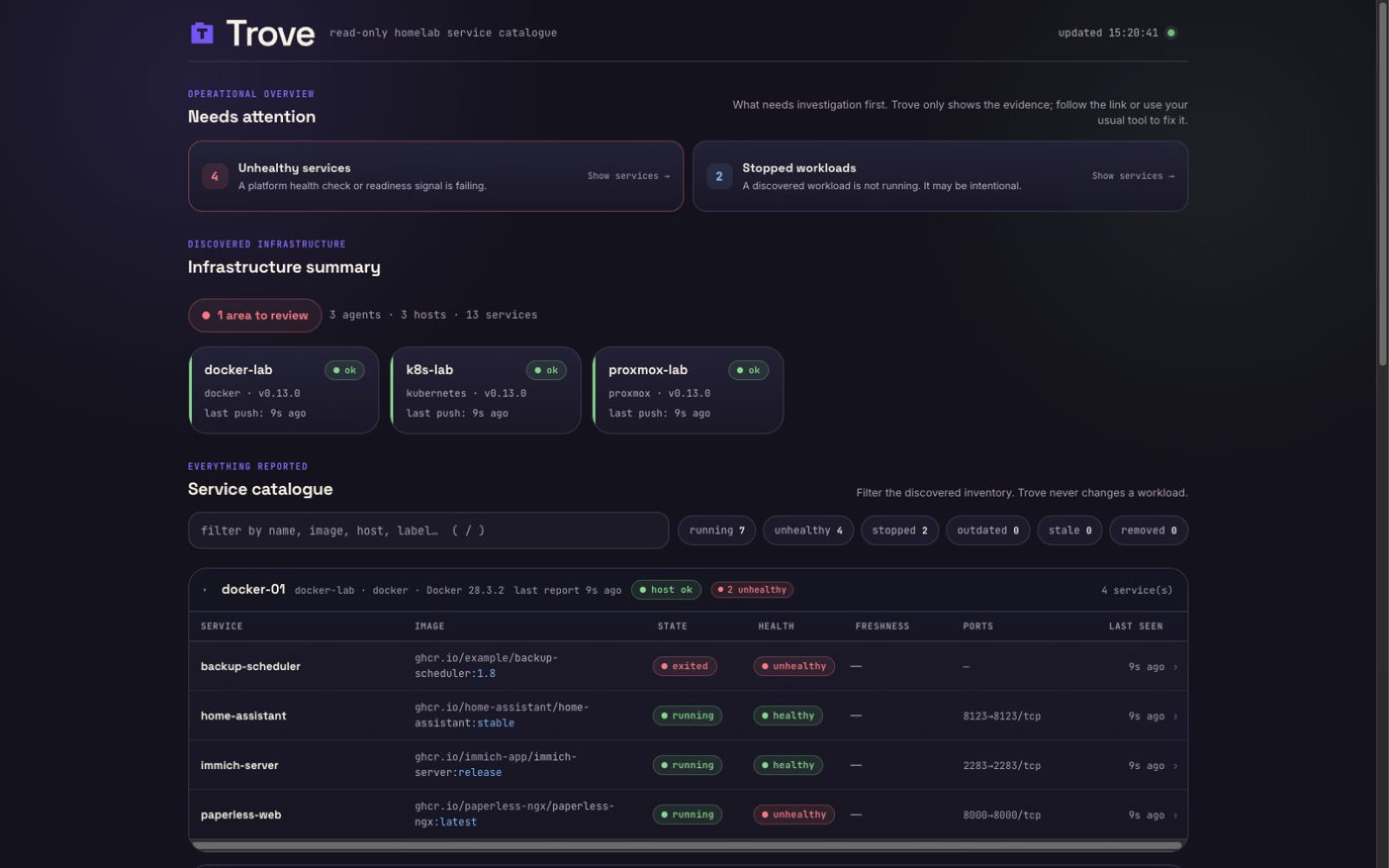
Most homelabs end up with services spread across a few different places:
- Docker hosts
- Kubernetes clusters
- Proxmox VMs and LXC containers
- bare-metal/systemd services
- old boxes you forgot were still doing something useful
Each platform has its own UI and its own idea of health. Trove gives you one catalogue view across all of them.
Use Trove when you want to answer questions like:
- What services are running across my whole environment?
- Which host does this thing live on?
- Which containers are stopped, unhealthy, stale, or outdated?
- Did an agent stop reporting?
- What changed recently?
- Are my running images behind their registry tags?
Trove is intentionally simple:
- Agents push reports to the server.
- The server never connects back to agents.
- Agents use read-only platform APIs.
- The database is a single SQLite file.
- The dashboard and read APIs can be protected with OIDC.
- The dashboard and API are read-only.
- Alerts are based on recorded state transitions.
That makes it NAT-friendly, easy to run, and much safer than a management plane.
- Quickstart - get the server and first agent running.
- Installation - choose Compose, systemd, or a mixed deployment.
- Architecture - how Trove works end to end.
- Server - server process, HTTP routes, background loops, and configuration.
- Agents - how agents collect and push full-state reports.
- Alerts-and-Digest - instant alerts, cooldowns, and email summaries.
- Image-Freshness - how registry digest checks work.
- Data-Model - SQLite schema, migrations, and report ingest semantics.
- Operations - running, upgrading, backing up, and troubleshooting Trove.
- Authentication - OIDC login, Authentik setup, logout, and API tokens.
- Security-Model - what Trove can and cannot touch.
- Development - build, test, release, and contributor notes.
The GitHub releases page is the source of truth for the current version and release notes. The examples in the repository are the source of truth for deployable Compose, Kubernetes, and systemd files.
Trove is not a replacement for Portainer, Kubernetes, Proxmox, or Uptime Kuma.
It does not:
- deploy workloads
- restart containers
- change Kubernetes resources
- modify Proxmox guests
- run commands on hosts
- replace uptime checks from outside the host
- expose a public management interface
That boundary is deliberate. Trove is the inventory and observation layer.

Trove
Read-only homelab service catalogue