Synthetic noise-driven time series with controllable structure for ML benchmarks.
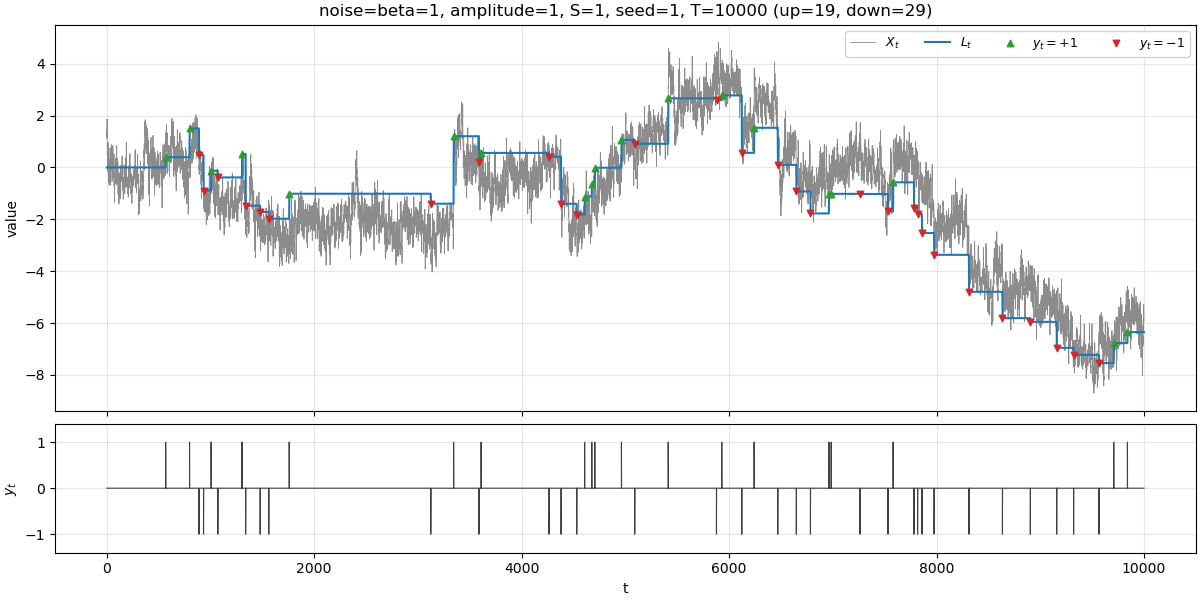
Each series is generated as
X_t = L_t + a * N(t)
where L_t is a piecewise-constant level with stochastic step lengths and an
optional seasonal sign bias, and N(t) is one of six configurable noise styles
(five 1/f^beta colored noises and one El-Nino-style noise). The canonical
dataset is a 6 x 3 x 2 x 10 = 360-element grid.
pip install chronoiseRequires Python >=3.10, numpy>=1.23, torch>=2.0.
from chronoise import (
    GeneratorConfig, NoiseKind, NoiseSpec,
    generate_series, NoiseSeriesDataset,
)

cfg = GeneratorConfig()

# Single realization.
r = generate_series(
    cfg,
    noise=NoiseSpec(NoiseKind.BETA, beta=1.0),
    amplitude=1.0,
    structural_mode=1,
    seed=0,
)
# r.X        : (T,) float64 observed series
# r.y        : (T,) int8 signed direction labels in {-1, 0, +1}
# r.y_binary : (T,) int8 binary bifurcation labels in {0, 1}
# r.L, r.N   : level and standardized noise components

# Full canonical dataset (360 series in memory).
ds = NoiseSeriesDataset(cfg)                  # default: signed labels {-1, 0, +1}
ds.save("dataset.npz")
ds = NoiseSeriesDataset.load("dataset.npz")

x, y = ds[0]  # torch tensors

# Switch to binary bifurcation labels for the break-vs-no-break task:
ds_bin = NoiseSeriesDataset(cfg, label_mode="binary")
x, y = ds_bin[0]                              # y in {0, 1}

# Both encodings are always stored — access either without rebuilding:
y_signed = ds.labels(0, mode="signed")
y_binary = ds.labels(0, mode="binary")
For a runnable example see examples/quickstart.py.
chronoise-build dataset.npz --T 8192 --n-seeds 10Add --keep-components to also store the level (L) and noise (N)
components in the archive. Add --label-mode {signed,binary} to choose the
default label encoding (both arrays are always persisted; this flag only
selects what __getitem__ returns):
chronoise-build dataset.npz --label-mode binaryAll knobs live on GeneratorConfig (chronoise/config.py): series length,
level statistics (sigma_L, gamma, T0, segment-length geometric
parameters), colored-noise frequency grid (K, f_low, f_high),
El-Nino-style noise (T1, T2, phi_ar), and the canonical product axes
(betas, amplitudes, structural_modes, n_seeds).
Series with the same seed share the same level trace across noise types,
which is convenient for paired comparisons.
This project is licensed under the MIT License.