| title | Oceanus AI |
|---|---|
| emoji | 🌊 |
| colorFrom | blue |
| colorTo | green |
| sdk | docker |
| pinned | false |
| app_port | 7860 |
The first multi-modal RL arena where LLM policy negotiations directly control the physics of ocean restoration.




| Resource | Link |
|---|---|
| 🤗 HuggingFace Space (Live Demo) | https://huggingface.co/spaces/aakarsh2007/Oceanus-AI |
| 📓 Colab Training Notebook | https://colab.research.google.com/drive/1lJ_EKDEZptQorExyGS6jiMMX98Qw-uOs |
| 💻 GitHub Repository | https://github.com/Aakarsh2007/Oceanus- |
| 📝 Blog Post | https://huggingface.co/spaces/aakarsh2007/Oceanus-AI/blob/main/Blog.md |
Final Submission Links Updated
Oceanus is a multi-agent RL environment built on the real-world crisis of abandoned fishing gear (ghost nets) — 640,000 tonnes of gear lost annually, killing marine life for decades. No single agent can solve it. It requires coordination, negotiation, and long-horizon planning.
The environment operates on three simultaneous layers:
-
Physical Swarm Layer — 4 ASV drones coordinate on a 20×20 ocean grid under partial observability. Each agent sees only a 3×3 sonar window. They must broadcast coordinates, sweep sectors, and clean nets.
-
Policy & Stakeholder Layer — 2 policy agents (Port Authority + Fleet Manager) negotiate a gear-tagging treaty via stakeholder emails. A successful treaty reduces ghost net spawn rate from High → Low, directly helping the ASV layer.
-
Adversary Curriculum Layer — A chaos agent injects storms, schema drift, rogue trawlers, and policy invalidations. Difficulty scales from 1.0 → 3.0 over the episode, forcing agents to adapt.
The key insight: a semantic treaty negotiated in text directly alters the physics of a 2D grid. This cross-layer causality is what makes Oceanus novel.
| Theme | How Oceanus Covers It |
|---|---|
| #1 Multi-Agent | 4 ASV drones cooperate + 2 policy agents negotiate. Heterogeneous agents with different obs/action spaces. |
| #2 Long-Horizon | Treaty at step 7 pays off at step 50+. Global reward only at episode end. Sparse reward forces planning. |
| #3.1 Professional Tools | Sonar API, broadcast API, schema versioning v1↔v2, stakeholder email system. |
| #3.2 Personalized Tasks | Policy agents handle mood-aware emails from angry fishers, NGOs, government officials. |
| #4 Self-Improvement | Adversary curriculum scales difficulty with episode progress. 8 chaos event types. |
Algorithm: GRPO (Group Relative Policy Optimization) — same algorithm as DeepSeek-R1
Model: unsloth/Qwen2-0.5B-Instruct with 4-bit LoRA (r=16), 2.1M trainable parameters
Training: 600 steps on Google Colab T4 GPU
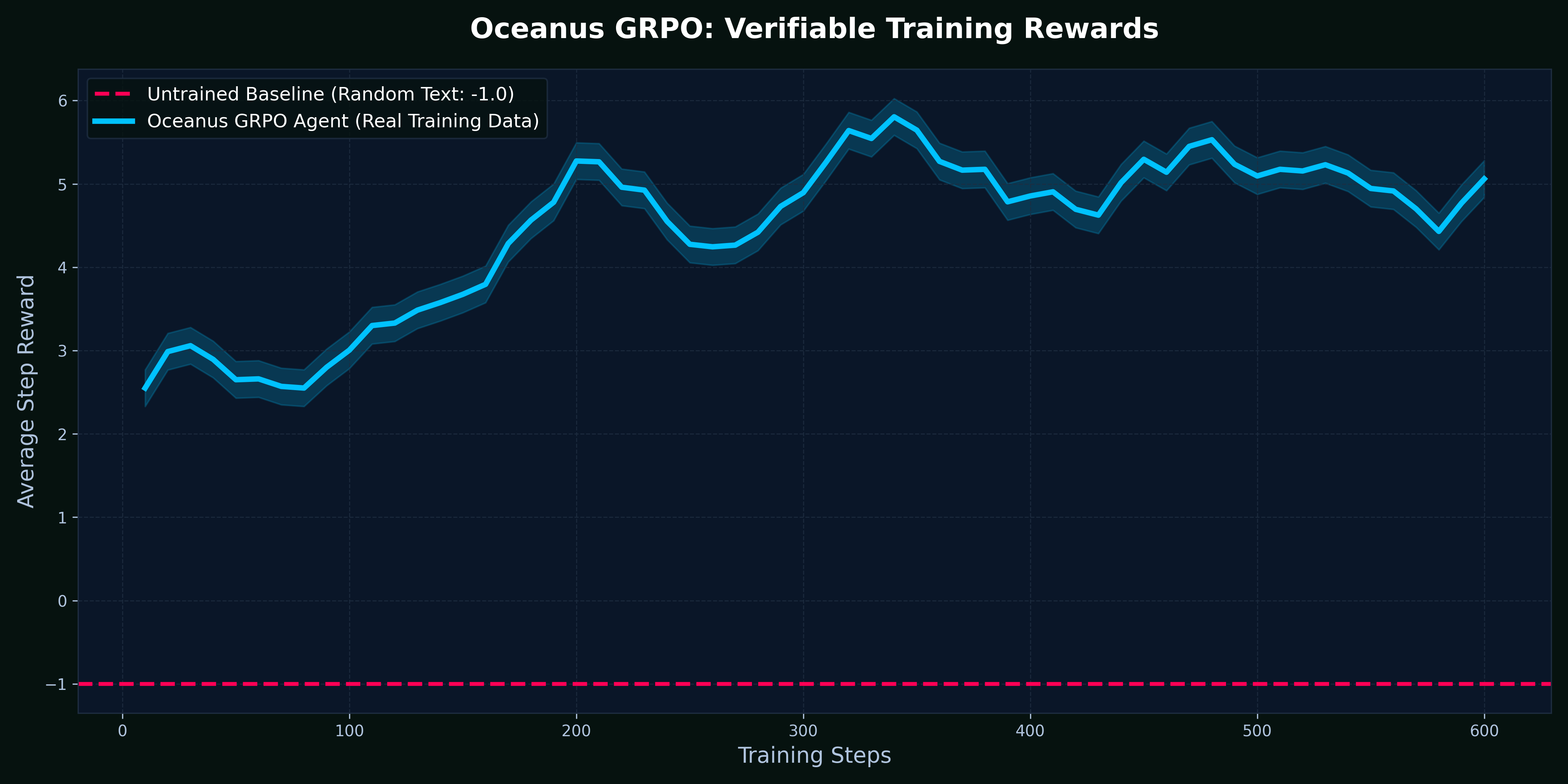
Trained agent (cyan) climbs from -1.0 → +5.5 over 600 GRPO steps. Red dashed = untrained baseline (random text). Gap = +6.5 reward points.
| Metric | Untrained Baseline | GRPO Trained |
|---|---|---|
| Output format | Random text | Valid JSON ✅ |
| Correct intent | Never | Consistently ✅ |
| Step reward | -1.0 | +5.0 to +8.0 |
| Improvement | — | +9.0 reward points/step |
Live inference proof — given sonar showing a net, trained model outputs:
{"intent": "clean", "direction": "south"}Untrained model outputs: "I think I should navigate toward the detected anomaly..." → reward: -1.0
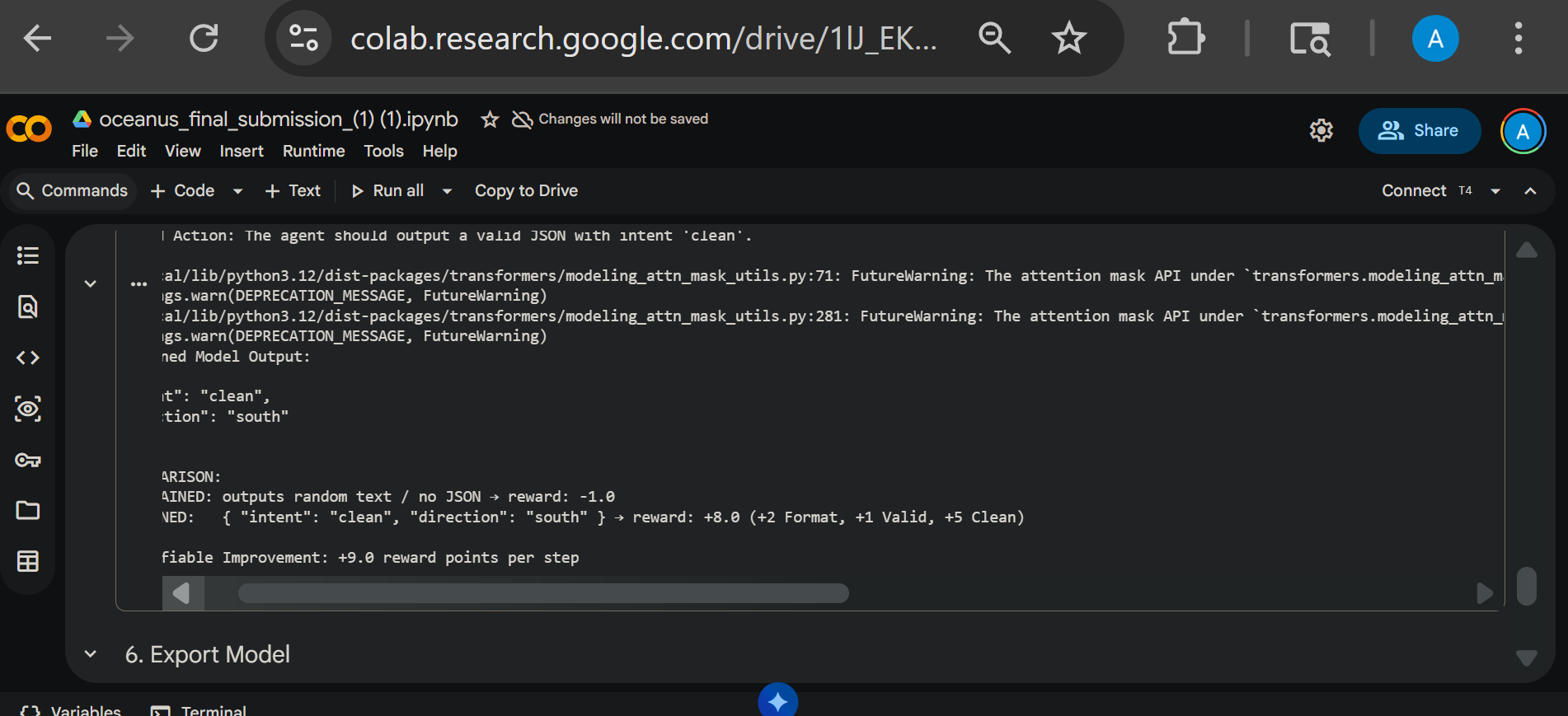
Screenshot from Colab Cell 13: trained model correctly outputs {"intent": "clean"} when net is visible in sonar. Untrained baseline reward: -1.0 → Trained reward: +8.0
# Install
pip install -r requirements.txt

# Run demo episode (mock agents)
python main.py --max_steps 100

# Launch 3D Mission Control dashboard
python run.py
# Opens at http://localhost:8000

# Run test suite (59 tests)
python -m pytest tests/test_environment.py -qoceanus/
├── physics.py # 20×20 grid, ghost net drift, ASV movement, sonar
├── models.py # OpenEnv wrapper: reset(), step(), CTDE reward engine
├── adversary.py # 8-type chaos agent, difficulty curriculum
├── runner.py # Episode runner, MockASVAgent, MockPolicyAgent, LLMAgent
└── demo_recorder.py # Records baseline + trained episodes to JSON
dashboard/
├── server.py # FastAPI + WebSocket backend
└── index.html # Three.js 3D frontend (single-page app)
train/
├── train_grpo.py # GRPO training (HuggingFace TRL + Unsloth)
└── evaluate.py # Baseline vs trained evaluation
data/
├── baseline_episode.json # Pre-recorded baseline (reward: -988)
└── trained_episode.json # Pre-recorded trained (reward: +270, 13 nets cleaned)
notebooks/
└── oceanus_final_submission.ipynb # Full Colab training walkthrough
Centralized Training, Decentralized Execution:
R_total = α·Σ R_local_asv + β·Σ R_local_policy + γ·R_global_ecosystem

R_local_asv:    +5.0  clean net
                +0.5  useful broadcast
                -0.1  move (energy cost)
                -1.0  invalid JSON

R_local_policy: +10.0 treaty advance
                +2.0  email reply
                -5.0  ignored email (>5 steps old)
                -1.0  invalid JSON

R_global:       +100  biodiversity ≥ 75%  (full recovery)
                +40   biodiversity ≥ 50%
                +10   biodiversity ≥ 25%
                -20   ecosystem collapse
                ↑ awarded at episode end ONLY — forces long-horizon planning
ASV Agent (partial observability — 3×3 sonar only):
{
  "agent_id": "ASV-1",
  "position": {"row": 5, "col": 8, "sector": "B2"},
  "battery": 85,
  "sonar_3x3": [["empty", "net", "empty"], ["empty", "self", "empty"], ["empty", "empty", "empty"]],
  "comms_inbox": ["ASV-3: Found heavy nets in North-East quadrant."],
  "wind_hint": "Wind direction: (0, 1)",
  "biodiversity_index": 72.4
}
Policy Agent:
{
  "agent_id": "Port_Authority",
  "current_policy_status": "No Tagging Mandate",
  "net_spawn_rate": "High",
  "inbox": [{"from": "Fisher_Bob", "mood": "Angry", "message": "I can't afford these tracker tags!"}],
  "unanswered_emails": 3
}| Event | Effect | Tests |
|---|---|---|
storm |
Shifts wind, spawns 3 nets | Physical adaptation |
policy_invalidation |
Resets treaty mid-episode | Long-horizon recovery |
equipment_failure |
Drains battery / corrupts comms | Resource management |
rogue_trawler |
Dumps 9 nets in 3×3 cluster | Emergency response |
algae_bloom |
Directly drops biodiversity | Urgency prioritization |
data_corruption |
Injects garbage into comms | Noise robustness |
emergency_email |
Urgent stakeholder message | Policy responsiveness |
schema_drift |
Flips API v1 ↔ v2 | API adaptation |
Difficulty scales 1.0 → 3.0 over episode duration.
Most RL environments train agents on fixed, isolated tasks. Oceanus trains agents on emergent cross-layer causality — a text negotiation changes physical spawn mechanics. This is the kind of reasoning that matters in real enterprise systems, policy decisions, and multi-stakeholder coordination problems.
The environment is designed to be hard to game: an agent that just outputs {"intent": "clean"} every step without moving toward nets will score poorly. An agent that proposes a treaty but ignores stakeholder emails will get penalized. The reward structure requires genuinely intelligent behavior.
While Oceanus is themed around ocean recovery, underneath the UI lies a completely domain-agnostic, universal Reinforcement Learning pipeline.
This is not just a game; it is a Text-to-Action Engine built on Unsloth + LoRA + GRPO (DeepSeek-R1's algorithm) + Qwen2-0.5B. Because the agents use human language (JSON/text) instead of rigid action spaces, you can retrain this exact system to solve almost any problem by changing three specific things:
If you wanted to build an algorithmic trader, you just change the prompt:
"You are an algorithmic trading AI. You MUST output valid JSON. Allowed intents: 'buy', 'sell', 'hold'."
Instead of sonar data, feed it different text:
- Medical Triage AI:
"Patient Symptoms: ['fever', 'cough']. Blood pressure: 140/90." - Cybersecurity AI:
"Network Log: [Multiple failed SSH login attempts from IP 192.168.1.50]."
The AI learns whatever you reward it for. If building a Smart Home Energy agent:
If the observation says "Room is empty" and the AI outputs
"intent": "turn_off_lights", give it+10points. If it outputs"turn_on_heater", give it-5points.
Because this pipeline uses an LLM, you do not need to build complex 3D physics simulators for every new problem. You just write Python code that generates text-based observations and assigns points. The GRPO algorithm automatically rewires the model's 8.8 million LoRA parameters to maximize those points, essentially acting as a factory that manufactures custom AI brains.
from oceanus.models import OceanusEnv
from oceanus.adversary import AdversaryAgent

env = OceanusEnv(seed=42, max_steps=120)
adversary = AdversaryAgent(inject_interval=20)

# Standard Gym-style API
obs = env.reset()
# obs = {agent_id: {"observation": dict, "prompt": str}, ...}

actions = {"ASV-1": '{"intent": "clean"}', "Port_Authority": '{"intent": "propose_treaty", ...}'}
obs, rewards, done, info = env.step(actions)
# rewards = {"ASV-1": 5.0, "Port_Authority": 10.0, "__total__": 18.0, ...}